If you're deciding between chair tai chi and chair yoga as a beginner, the short answer is this: chair tai chi is better if you want continuous, flowing movement that builds balance and coordination, while chair yoga is better if you want static stretches, deeper flexibility work, and a stronger mind-body breathing focus. Both are low-impact, seated exercise systems designed for people with limited mobility, seniors, and anyone easing into movement for the first time — and I'll break down exactly how they differ so you can pick the right one for your body and goals.
What Is the Difference Between Chair Tai Chi and Chair Yoga?
The core difference between chair tai chi and chair yoga is movement style: chair tai chi uses continuous, circular, flowing sequences, while chair yoga uses static poses held for several breaths. I practice and recommend both, but they come from entirely different traditions and train your body in different ways.
Chair Tai Chi Explained
- Origin: Adapted from Chinese martial arts, specifically Tai Chi Chuan, a practice built around slow, weighted, continuous motion.
- Movement pattern: Sequences of connected, circular arm and upper-body movements performed while seated, mimicking standing tai chi forms like "Cloud Hands" and "Parting the Wild Horse's Mane."
- Focus: Weight shifting, coordination, rhythm, and continuous motion rather than isolated stretches. The gentle joint mobilization of repeated circular arm movements supports synovial fluid circulation and range of motion maintenance.
- Pace: Slow and unbroken — one movement flows into the next without pausing.
- Best known for: Balance training and fall-risk reduction, even in a seated position. A randomized controlled trial found that three months of sitting tai chi training improved sitting balance and accuracy in a finger-pointing task among older adults.[^1]
Chair Yoga Explained
- Origin: Adapted from traditional Hatha yoga, modifying standing and floor poses (asanas) to be performed seated or with chair support.
- Movement pattern: Discrete poses — seated forward folds, spinal twists, gentle backbends — each held for a breath count.
- Focus: Flexibility, muscular strength, and breath-linked stillness. Common adaptations include seated stretches, trunk rotations, supported standing using the chair for stability, breathwork, and brief relaxation or meditation.
- Pace: Pose-and-hold, with rest breaks built into the sequence.
- Best known for: Pain relief and flexibility gains. A 2016 study published in the Journal of the American Geriatrics Society found that doing 45 minutes of chair yoga twice weekly for eight weeks helped reduce joint pain in older adults with osteoarthritis.[^2]
Quick Comparison Table: Chair Tai Chi vs Chair Yoga at a Glance
| Feature | Chair Tai Chi | Chair Yoga |
|---|---|---|
| Origin | Chinese martial art (Tai Chi Chuan) | Indian yoga tradition (Hatha yoga) |
| Movement style | Continuous, flowing, circular | Static poses, held and released |
| Primary benefit | Balance, coordination, fall prevention | Flexibility, pain relief, relaxation |
| Breathing role | Natural, coordinated with movement | Central; often paced and counted (pranayama) |
| Typical pace | Slow, unbroken sequences | Pose-hold-release, rest between poses |
| Best evidence base | Falls, balance, functional mobility | Pain, joint stiffness, mood, quality of life |
| Learning curve for beginners | Moderate (sequence memorization) | Low (poses are simpler to isolate and repeat) |
Chair Tai Chi vs Chair Yoga for Beginners: Which Should You Choose?
The right choice between chair tai chi and chair yoga for beginners comes down to your primary goal, current mobility, and what kind of movement you personally enjoy. Neither is objectively "better" — they're built for different outcomes.
Signs Chair Tai Chi Is the Better Fit for You
- You're focused on fall prevention or balance. A systematic review and meta-analysis of 24 randomized controlled trials found that tai chi can effectively reduce the risk of falls in older adults and decrease the number of falls.[^3]
- You want a mental "flow state." The continuous choreography demands focused attention, which many beginners find meditative.
- You have arthritis or joint pain that limits static holds. Doctors recommend tai chi for people with musculoskeletal conditions because it improves flexibility and builds muscle strength gradually, taking joints gently through their range of motion.
- You enjoy rhythm and repetition over isolated stretching.
- You want an evidence-backed medical recommendation. The American College of Rheumatology and the Arthritis Foundation jointly published updated guidelines that "strongly recommend" tai chi for managing osteoarthritis of the knee and hip.
Signs Chair Yoga Is the Better Fit for You
- You want to target flexibility and range of motion directly. A small study of 35 older women in community care found that 12 weeks of chair yoga improved strength in the hands, arms, and legs, along with improvements in balance, agility, gait, and limb flexibility.[^4]
- You're managing chronic pain, especially from osteoarthritis. A randomized clinical trial examined whether chair yoga could reduce frailty severity in community-dwelling older adults with lower extremity osteoarthritis over an eight-week, twice-weekly program.[^5]
- You want structured breathing practice built into every session (pranayama).
- You prefer working one muscle group or joint at a time rather than continuous sequences.
- You're also interested in stress and anxiety relief through stillness rather than movement. Chair yoga was effective in improving physical function and reducing stiffness in older adults with osteoarthritis.[^6]
Can Beginners Do Both Chair Tai Chi and Chair Yoga?
- Yes — many beginners alternate between the two or combine them in one routine.
- Complementary strengths: tai chi trains dynamic balance and coordination; yoga trains static flexibility and deep stretching.
- Suggested starting pattern: two chair tai chi sessions per week for movement and balance, plus one or two chair yoga sessions for flexibility and relaxation.
- No conflict between the two: neither practice requires equipment or specific clothing that would prevent switching between them.
- Recovery consideration: because both are low-impact, there's minimal risk of overtraining by doing both in the same week.
Origins and Philosophy Behind Each Practice
Chair tai chi and chair yoga trace back to entirely different cultural and philosophical traditions, and that history still shapes how each practice feels today.
The Roots of Tai Chi and How Chair Tai Chi Adapts It
- Martial arts foundation: Tai chi is a traditional martial art practiced for defense and health benefits in Chinese society, built around balance-based, slow, rhythmic movements performed in a continuous sequence.
- Center of gravity focus: In tai chi, the center of gravity moves with the movements of each foot, and practitioners maintain different postures while keeping their center of gravity within a changing support base to challenge balance control.
- Chair adaptation: Removes the standing weight-shifting element but preserves the upper-body circular motion, weight distribution through the seated base, and continuous flow.
- Philosophy retained: The concept of "yin and yang" — soft, yielding movement paired with rooted stability — still applies even while seated.
The Roots of Yoga and How Chair Yoga Adapts It
- Spiritual and physical tradition: Yoga originated as a holistic Indian practice combining physical postures (asana), breath control (pranayama), and meditation.
- Chair adaptation: Standing and floor poses are modified so the chair either supports the body directly (seated poses) or acts as a balance aid (supported standing poses).
- Philosophy retained: The union of breath and movement remains central — each pose is still typically linked to an inhale or exhale.
- Modern classification: Chair yoga is generally rooted in gentle Hatha yoga rather than more vigorous styles like Vinyasa or Ashtanga.
How Philosophy Shapes the Beginner Experience
- Tai chi feels like a "moving meditation" — beginners are guided to keep moving and stay relaxed within the motion.
- Yoga feels like "structured stillness" — beginners are guided to hold a shape and breathe intentionally within it.
- Neither requires prior spiritual or martial arts knowledge to start as a complete beginner.
- Both traditions emphasize mindfulness, just expressed through different physical vehicles (motion vs. stillness).
Movement Style: Chair Tai Chi's Flow vs Chair Yoga's Poses
The single biggest practical difference between chair tai chi and chair yoga for beginners is how movement is structured — continuous flow versus discrete, held poses.
Continuous, Flowing Movements in Chair Tai Chi
- No stopping points: Movements blend into one another in a loop, so there's rarely a moment of complete stillness.
- Weight and momentum: Even seated, tai chi uses subtle shifts in weight through the hips and torso to generate flow.
- Sequence-based learning: Beginners memorize a short "form" (a set order of movements) rather than individual poses.
- Upper-body emphasis: Because standing weight-shifting is removed, chair tai chi relies heavily on arm, shoulder, and torso circles to replicate the balance-challenging effect of standing tai chi.
Static Holds and Stretches in Chair Yoga
- Hold-and-release structure: Each pose is held for a set number of breaths (often 3–8) before releasing and moving to the next.
- Isolated targeting: Poses can target one specific muscle group or joint — for example, a seated spinal twist isolates the obliques and lower back.
- Pose variety: Includes forward folds, side bends, gentle backbends, hip openers, and supported standing poses using the chair for balance.
- Built-in rest: Because poses are discrete, beginners can pause between them without breaking the "flow" of a routine.
Which Movement Style Is Easier for Beginners to Learn
| Learning Factor | Chair Tai Chi | Chair Yoga |
|---|---|---|
| Memorization required | Higher — must learn sequence order | Lower — poses can be practiced individually |
| Physical coordination needed | Moderate to high (multi-limb coordination) | Low to moderate (mostly single-joint focus) |
| Ease of stopping mid-session | Harder — flow is continuous | Easy — natural pause points between poses |
| Best for visual learners | Yes (mirrors instructor's continuous motion) | Yes (each pose is a clear, static image to copy) |
Physical Benefits of Chair Tai Chi vs Chair Yoga for Beginners
Both chair tai chi and chair yoga deliver measurable physical benefits for beginners, but the research shows they tend to excel in different areas — tai chi leans toward balance and fall prevention, while yoga leans toward flexibility and pain relief.
Balance and Coordination Benefits
- Chair tai chi has the stronger balance evidence base. A systematic literature review and meta-analysis examining 12 studies involving 2,901 participants found that tai chi outperforms conventional exercise in improving functional mobility and balance in healthy older adults.[^7]
- Even seated, the effect holds. The purpose of one study was to examine the effects of three months of sitting tai chi training on sitting balance control and eye-hand coordination in older adults, and the results demonstrated that sitting tai chi can improve sitting balance and accuracy in a finger-pointing task.[^1]
- Chair yoga also improves balance, though usually as a secondary benefit alongside strength and flexibility work. A study found improvements in balance, agility, gait, and limb flexibility following chair yoga.[^4]
Flexibility and Range of Motion Benefits
- Chair yoga is generally the stronger choice for flexibility gains because its pose-and-hold structure is specifically designed to lengthen muscles.
- Chair tai chi still improves range of motion, particularly in the shoulders, wrists, and spine, through repeated circular motion. The slow, circular arm movements of chair tai chi take the shoulders, elbows, wrists, and spine through their full range of motion without loading the joints.
- Both practices are considered joint-friendly low-impact options compared to standing or floor-based exercise.
Strength and Muscle Engagement Benefits
- Chair yoga has documented strength gains in beginners. A small study of 35 older women in community care found that 12 weeks of chair yoga improved strength in the hands, arms, and legs.[^4]
- Chair yoga also improves grip and body-region strength. One study found that chair yoga significantly improves handgrip strength, upper-body strength, lower-body strength, and static and dynamic balance.[^2]
- Chair tai chi builds strength more gradually, largely through sustained isometric holds during weight-shifting movements rather than targeted strength poses.
Joint-Friendly Considerations for Seniors and Beginners
- Both are considered safe for arthritic joints, with major endorsements from health organizations.
- Chair tai chi is well tolerated by arthritis patients. Chair tai chi's slow, non-impact movements are generally well-tolerated by people with arthritis.
- Chair yoga reduces joint pain in clinical trials. A study published in the Journal of the American Geriatrics Society found that doing 45 minutes of chair yoga twice weekly for eight weeks helped reduce joint pain in older adults with osteoarthritis.[^2]
- Neither practice involves jumping, running, or high-load resistance that would stress inflamed joints.
Mental and Emotional Benefits Compared
Beyond the physical side, chair tai chi and chair yoga both support mental and emotional wellbeing for beginners, though they approach it from different angles — movement-based calm versus breath-based calm.
Stress Relief and Relaxation in Chair Tai Chi
- Well-documented anxiety and stress reduction. A review found that in community-dwelling participants, between one hour and up to one year of regular tai chi significantly increased psychological well-being and reduced stress, with an effect size of 0.66.[^8]
- Effective across age groups. A meta-analysis of 12 randomized controlled trials involving 1,057 college students found tai chi significantly reduced depression symptoms and also demonstrated significant effects in alleviating anxiety and stress.[^9]
- Mechanism: Tai chi has been shown to influence stress regulation by enhancing parasympathetic activity, reducing sympathetic arousal, and attenuating cortisol responses, promoting psychophysiological homeostasis.[^10]
Mindfulness and Breathwork in Chair Yoga
- Breath-driven relaxation response. Yoga activates the parasympathetic nervous system through slow breath, deliberate movement, and sustained stillness, counteracting the stress response and restoring the body to physiological equilibrium.
- Measurable within a single session. A single session of pranayama or restorative yoga can produce measurable shifts in heart rate and cortisol within twenty to thirty minutes.
- Emotional wellbeing findings in seated yoga: Chair yoga can reduce pain and improve mood, though it had no measurable impact on frailty scores in some studies of community-dwelling older adults with osteoarthritis.[^11]
Which Practice Offers Better Mental Health Support for Newcomers
- If you want active, moving stress relief — chair tai chi's continuous motion is easier to "lose yourself in."
- If you want breath-focused calm and quiet reflection — chair yoga's pose-and-breathe structure is more direct.
- Both are backed by NIH-recognized research. Several mind and body approaches, including relaxation techniques, yoga, tai chi, hypnotherapy, and meditation, may be useful for managing symptoms of stress.[^12]
Breathing Techniques in Chair Tai Chi and Chair Yoga
Breathing is handled very differently in these two practices, and understanding the distinction helps beginners know what to expect from their first class.
Breath Control in Chair Tai Chi Practice
- Breath follows movement, rather than movement being counted out in breath cycles.
- Natural diaphragmatic breathing is encouraged throughout the flowing sequence rather than specific breath-holding techniques.
- Deep, slow breathing supports relaxation as a byproduct of the slow tempo, not a separate instructed technique.
Pranayama and Breathing in Chair Yoga
- Breath is a formal, named component (pranayama) and is often practiced as its own segment of class.
- Specific techniques may be introduced, such as slow nasal breathing or alternate nostril breathing, to calm the nervous system. One study on alternate nostril breathing found that parasympathetic tone was enhanced appreciably in participants after a six-week training period.[^13]
- Physiological effects are well studied. Research shows that controlled breathing can activate the parasympathetic nervous system, helping lower stress levels while promoting relaxation, and leading to a decrease in heart rate and blood pressure.[^14]
Why Breathwork Matters for Beginners in Both Practices
- Improves session tolerance: proper breathing reduces the sense of effort during slow, sustained movement or holds.
- Supports better outcomes: breath-linked practice is associated with lower resting heart rate and blood pressure over time. A meta-analysis of yoga, mindfulness-based stress reduction, and stress-related physiological measures reported reductions in resting cortisol, resting heart rate, and blood pressure across intervention studies.
- Beginner tip: don't force deep breathing on day one — let it develop naturally as movements or poses become familiar.
Who Should Try Chair Tai Chi vs Chair Yoga for Beginners
Different populations tend to benefit more from one practice over the other, based on their specific mobility needs, health conditions, and goals.
Best For Seniors and Older Adults
- Chair tai chi: particularly strong for fall-prevention-focused seniors. The CDC notes that encouraging older adults to participate in exercise programs that can help improve strength and balance, like tai chi, is a key recommendation for reducing fall risk.[^15]
- Context on why this matters: Fourteen million, or 1 in 4 Americans age 65 and older, falls each year, and falls are the leading cause of fatal and non-fatal injuries among older adults.[^16]
- Chair yoga: strong for seniors prioritizing flexibility, mood, and independence. Chair yoga is a safe and adaptable practice that improves mobility, strength, mood, and overall quality of life in older adults, including those with chronic conditions.
Best For People With Limited Mobility or Disabilities
- Both practices remove the standing-balance barrier that prevents many people from doing traditional tai chi or yoga.
- Chair yoga specifically designed for accessibility. Chair yoga is particularly suited for older adults with joint pain and inflammation, limited flexibility, or balance concerns who may feel unsafe in traditional yoga settings.
- Seated yoga has shown falls-prevention value too. Seated yoga can reduce pain, fear of falling, and improve mobility and balance.
Best For People Recovering From Injury or Surgery
- Both are low-impact and generally safe once cleared by a physician or physical therapist.
- Chair tai chi's gentle joint loading is often used in rehabilitation settings for cardiac and orthopedic recovery.
- Chair yoga's isolated poses allow recovering patients to skip or modify specific movements that stress an injured area.
Best For Office Workers and Desk-Bound Beginners
- Chair yoga is easy to slot into a workday for quick stretches targeting the neck, shoulders, and lower back.
- Chair tai chi offers a short mental reset and coordination break during long sitting stretches.
- Neither requires changing clothes or leaving the desk area, making both realistic workplace wellness options.
Best For People With Arthritis or Chronic Pain
- Both are officially endorsed for arthritis management. Chair tai chi is recommended by several major health organizations for older adults and those with mobility limitations, including the Arthritis Foundation and the National Council on Aging.
- Fibromyalgia-specific evidence favors tai chi. A landmark study published in the New England Journal of Medicine demonstrated that tai chi reduced fibromyalgia symptoms by 42%, outperforming aerobic exercise.
- Chair yoga's pain outcomes are mixed but generally positive. One pilot study found chair yoga was effective in improving physical function and reducing stiffness, though it was not effective in reducing pain level or depressive symptoms in that particular sample.[^6]
Safety Considerations for Beginners
Both practices are considered low-risk, but beginners should still follow a few safety fundamentals before starting chair tai chi or chair yoga.
Chair Selection and Setup Tips
- Use a sturdy, armless chair without wheels so it doesn't roll or tip during movement.
- Feet flat on the floor: knees should be roughly level with or slightly below hip height.
- Avoid soft, cushioned seating like couches or recliners, which reduce postural stability.
- Position the chair away from walls or furniture to allow full range of arm and shoulder motion.
Common Mistakes Beginners Make in Chair Tai Chi
- Rushing the movements instead of maintaining the slow, controlled pace that produces the balance benefits.
- Holding tension in the shoulders rather than staying relaxed throughout the flow.
- Skipping the weight-shift cues, which are where much of the coordination benefit comes from, even seated.
Common Mistakes Beginners Make in Chair Yoga
- Overstretching in early sessions before the body has warmed up.
- Holding the breath during poses instead of breathing steadily through the hold.
- Forcing a pose to look like the instructor's rather than modifying for personal range of motion.
When to Consult a Doctor Before Starting Either Practice
- Recent surgery, joint replacement, or cardiac event.
- Uncontrolled blood pressure or dizziness with movement.
- Severe or acutely inflamed arthritis flare-ups. Those with severe or acutely inflamed joints should consult their healthcare provider before beginning.
- Any new or unexplained pain that occurs during practice.
What a Beginner Class Looks Like
Knowing the typical structure of a chair tai chi or chair yoga class in advance helps beginners feel prepared and reduces first-class anxiety.
Typical Structure of a Chair Tai Chi Session
- Warm-up (5 minutes): gentle seated shoulder rolls and neck stretches.
- Form practice (20–30 minutes): guided repetition of a short flowing sequence, such as Cloud Hands or Wave Hands Like Clouds.
- Cool-down (5 minutes): slow, deep breathing while seated in stillness.
Typical Structure of a Chair Yoga Session
- Centering (5 minutes): seated breath awareness and gentle neck/shoulder rolls.
- Pose sequence (20–30 minutes): a series of held poses — seated twists, forward folds, gentle backbends, supported standing poses.
- Relaxation (5–10 minutes): seated or supported final relaxation with slow breathing.
How Long Each Session Usually Lasts
| Session Length | Chair Tai Chi | Chair Yoga |
|---|---|---|
| Typical class time | 30–60 minutes | 30–60 minutes |
| Minimum effective beginner session | 15 minutes | 15 minutes |
| Recommended weekly frequency | Daily practice recommended by the Arthritis Foundation | 2–3 sessions per week for measurable gains |
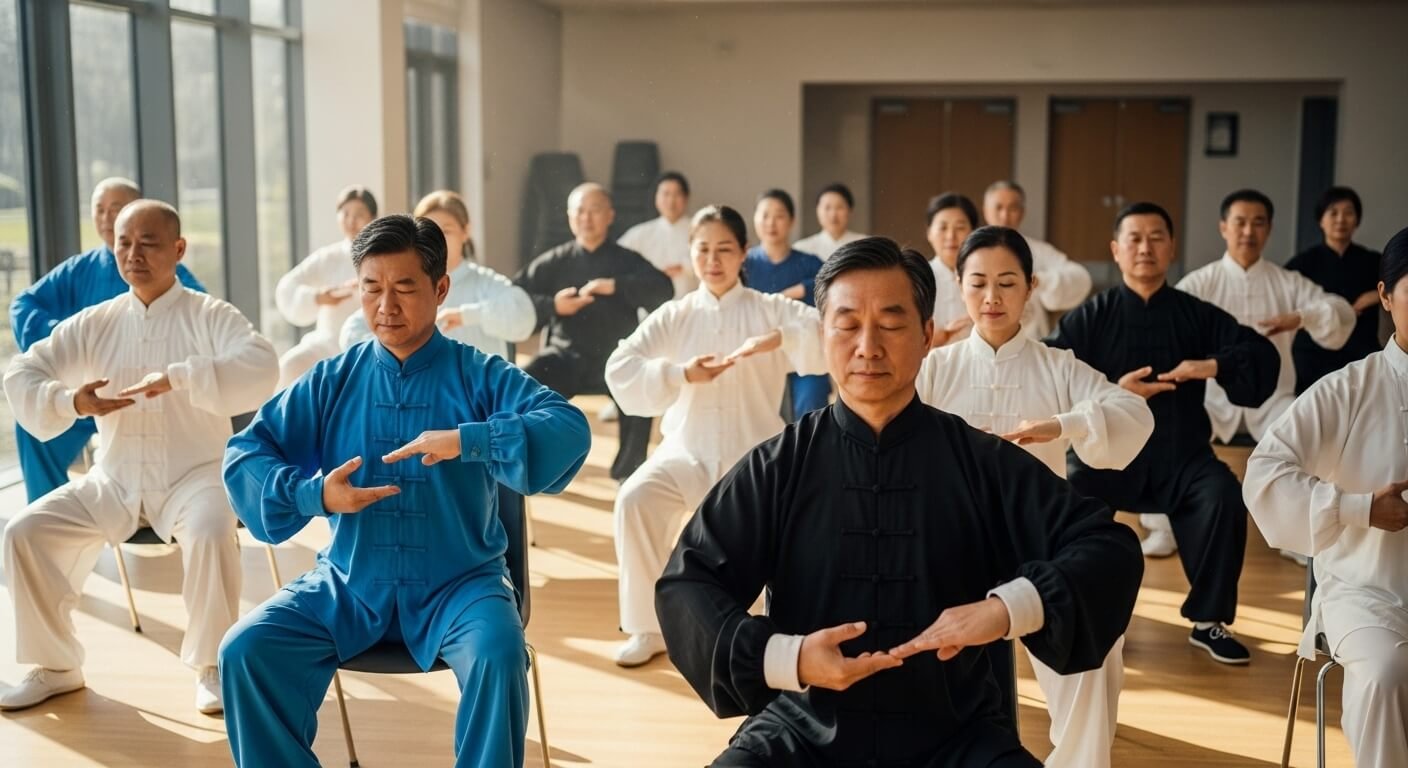
The Arthritis Foundation recommends 15 minutes per day of tai chi practice for meaningful health benefits.
Sample Beginner-Friendly Moves to Try
Trying a few simple movements from each practice is the best way to feel the difference between chair tai chi's flow and chair yoga's static holds firsthand.
3 Simple Chair Tai Chi Movements for Beginners
- Cloud Hands (seated): Slowly circle both hands in front of the body, one rising as the other falls, shifting slight weight side to side through the hips.
- Parting the Wild Horse's Mane (seated): Open one arm diagonally up and out while the other sweeps down and across the body, alternating sides.
- Gentle Wrist and Shoulder Circles: Small, continuous circles used as a warm-up or transition between larger movements.
3 Simple Chair Yoga Poses for Beginners
- Seated Cat-Cow: Arch and round the spine in rhythm with the breath while seated at the edge of the chair.
- Seated Spinal Twist: Rotate the torso gently toward one side, holding the chair back for support, then switch sides.
- Seated Forward Fold: Hinge forward from the hips over the legs, letting the arms hang, to stretch the lower back and hamstrings.
How to Combine Chair Tai Chi and Chair Yoga in One Routine
- Start with chair tai chi as a dynamic warm-up to raise circulation and loosen joints.
- Follow with chair yoga poses to deepen the stretch once muscles are warm.
- Finish with breathwork (pranayama) from the yoga tradition to close the session in a calm state.
- Keep total combined session under 45–60 minutes for beginners to avoid fatigue.
Equipment and Space Requirements
Both chair tai chi and chair yoga are accessible practices that require minimal setup, making them realistic for beginners to start at home immediately.
What You Need for Chair Tai Chi at Home
- A sturdy armless chair (dining chair style, not a recliner).
- Comfortable, non-restrictive clothing that allows arm and shoulder movement.
- A clear space of roughly 4×4 feet around the chair for arm extension.
- Optional: calming instrumental music to match the slow tempo.
What You Need for Chair Yoga at Home
- A sturdy chair, ideally without arms for full range of motion in seated twists.
- A yoga mat or non-slip surface under the chair for stability.
- Comfortable, stretch-friendly clothing.
- Optional props: a small cushion or folded towel for lower back support.
Choosing the Right Type of Chair for Either Practice
- Avoid: office chairs with wheels, recliners, chairs with soft cushioning, or chairs with high armrests that restrict movement.
- Look for: a flat, firm seat; a stable four-legged base; and a seat height that keeps knees roughly level with hips.
- Dual-use tip: a standard kitchen or dining chair works well for both practices, so beginners don't need separate equipment for each.
Where to Learn: Classes, Videos, and Apps
Beginners have multiple entry points into chair tai chi and chair yoga, from free community programs to paid online platforms.
Finding In-Person Chair Tai Chi Classes for Beginners
- Senior centers and community centers frequently offer low-cost or free chair tai chi classes.
- Arthritis Foundation-endorsed programs, such as Tai Chi for Arthritis and Fall Prevention, are widely available and evidence-based.
- Hospitals and rehabilitation centers sometimes run tai chi programs as part of cardiac or fall-prevention rehab.
Finding In-Person Chair Yoga Classes for Beginners
- Yoga studios increasingly offer dedicated chair yoga or "gentle yoga" classes.
- Senior centers and assisted living facilities commonly run weekly chair yoga sessions.
- Physical therapy clinics sometimes incorporate chair yoga into rehabilitation plans.
Best Online Resources and Videos for Both Practices
- YouTube: Both chair tai chi and chair yoga have extensive free, beginner-specific video libraries from certified instructors.
- Subscription apps: Several fitness and wellness apps offer structured, progressive chair-based tai chi and yoga programs.
- Live virtual classes: Many senior centers and studios now stream classes, useful for beginners who prefer real-time instructor feedback without leaving home.
Cost Comparison for Beginners
Cost is rarely a barrier for either practice, since both chair tai chi and chair yoga are widely offered at low or no cost through community programs, though private and studio options vary.
Typical Costs of Chair Tai Chi Classes
| Format | Typical Price |
|---|---|
| Drop-in class | $15 to $25 per class |
| Monthly membership | $60 to $150 per month |
| Senior center classes | Often $2–$5 per session, sometimes free |
| Private instruction | Typically $50 to $100 or more per hour |
Typical Costs of Chair Yoga Classes
| Format | Typical Price |
|---|---|
| Drop-in class | $15 to $30, varying by location and studio quality |
| 5-class package | $80 to $100, roughly a 10–20% discount versus drop-in |
| Monthly unlimited membership | $100 to $150 per month |
| Online class | $10 to $20 per session, with monthly subscriptions around $75 to $100 |
Free vs Paid Options for Getting Started
- Free options: senior center drop-ins, library programs, YouTube videos, and community health department wellness initiatives.
- Low-cost options: many senior centers charge $2–$5 per class or offer punch cards. Some community fitness programs price sessions as low as $3 per class or 10 sessions for $20.
- Paid options: private instruction, studio memberships, and subscription apps offer more structured, one-on-one progression for beginners who want faster skill-building.
- Recommendation for absolute beginners: start with a free or low-cost community class before investing in a paid membership, since both practices have a learning curve best assessed in person first.
Long-Term Progression: Beyond the Beginner Stage
Chair tai chi and chair yoga are both designed to scale with a beginner's growing strength, flexibility, and confidence, eventually opening the door to more advanced or standing variations.
How Chair Tai Chi Practice Evolves Over Time
- Longer forms: beginners typically start with a handful of movements and progress to full traditional forms (which can include 24 or more movements).
- Increased complexity: later stages add more intricate weight shifts and multi-directional sequences.
- Improved outcomes with consistency: Tai chi's effectiveness increases with the duration and frequency of exercise, according to subgroup analysis from a large systematic review.[^3]
How Chair Yoga Practice Evolves Over Time
- Deeper holds: beginners progress from 3–5 breath holds to longer, more challenging holds as flexibility improves.
- Expanded pose library: advanced practitioners add supported standing poses and more complex twists.
- Sustained benefits shown over time: Improvements in pain interference from chair yoga programs have been shown to be sustained at a three-month follow-up.[^17]
Transitioning From Chair-Based to Standing Practice
- Not required: many practitioners continue chair-based practice indefinitely for its accessibility and joint-friendliness.
- Gradual bridge option: "supported standing" variations, using the chair for balance while performing standing-adjacent movements, are a common middle step.
- Consult an instructor first: before transitioning to standing tai chi or full yoga classes, beginners should confirm with an instructor or physical therapist that their balance and strength support the change.
Sources
[^1]: PubMed — https://pubmed.ncbi.nlm.nih.gov/25060039/
[^2]: Care.com — https://www.care.com/c/chair-yoga-for-seniors/
[^3]: NCBI/PMC — https://www.ncbi.nlm.nih.gov/pmc/articles/PMC10509476/
[^4]: Medical News Today — https://www.medicalnewstoday.com/articles/chair-yoga-for-seniors
[^5]: NCBI/PMC — https://www.ncbi.nlm.nih.gov/pmc/articles/PMC6841120/
[^6]: PubMed — https://pubmed.ncbi.nlm.nih.gov/22533347/
[^7]: Hebrew SeniorLife — https://www.hebrewseniorlife.org/news/new-research-suggests-tai-chi-outperforms-conventional-exercise-improving-mobility-and-balance
[^8]: NCBI/PMC — https://pmc.ncbi.nlm.nih.gov/articles/PMC3917559/
[^9]: PubMed — https://pubmed.ncbi.nlm.nih.gov/42491127/
[^10]: NCBI/PMC — https://pmc.ncbi.nlm.nih.gov/articles/PMC13180939/
[^11]: OBM Geriatrics — https://www.lidsen.com/journals/geriatrics/geriatrics-06-02-197
[^12]: NCCIH / NIH — https://www.nccih.nih.gov/health/providers/digest/mind-and-body-approaches-for-stress-science
[^13]: NCBI/PMC — https://pmc.ncbi.nlm.nih.gov/articles/PMC3681046/
[^14]: Aura Wellness Center — https://aurawellnesscenter.com/2026/05/05/benefits-of-pranayama-the-yoga-of-breath/
[^15]: CDC STEADI — https://www.cdc.gov/steadi/media/pdfs/STEADI_ClinicianFactSheet-a_1.pdf
[^16]: National Council on Aging — https://www.ncoa.org/article/get-the-facts-on-falls-prevention/
[^17]: News-Medical — https://www.news-medical.net/health/Health-Benefits-of-Chair-Yoga-for-Seniors.aspx