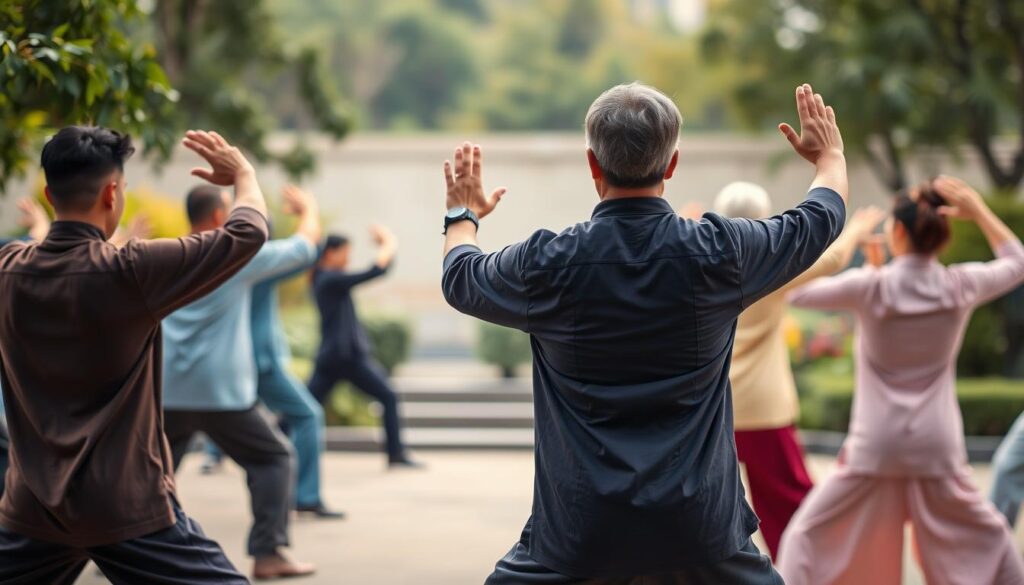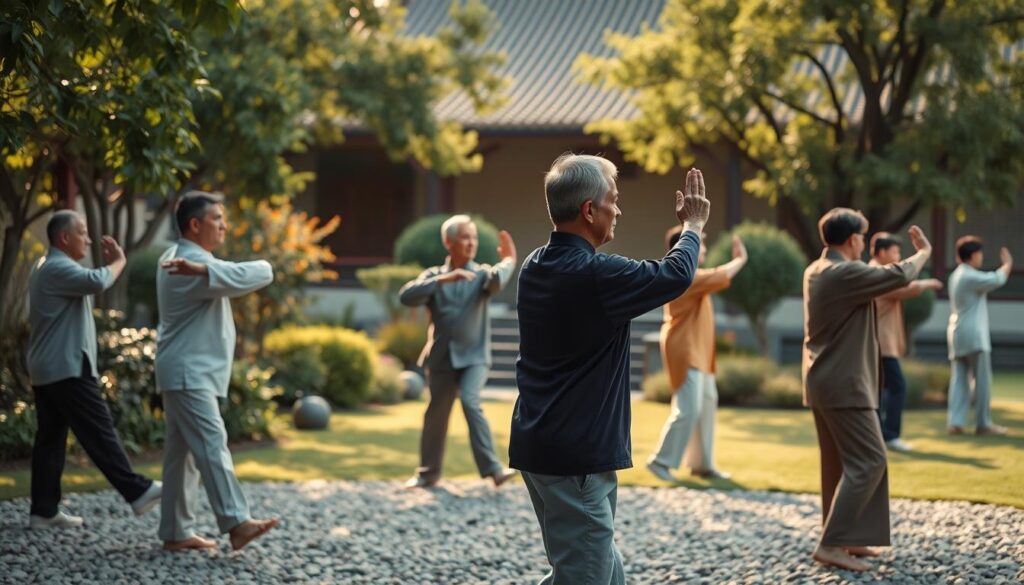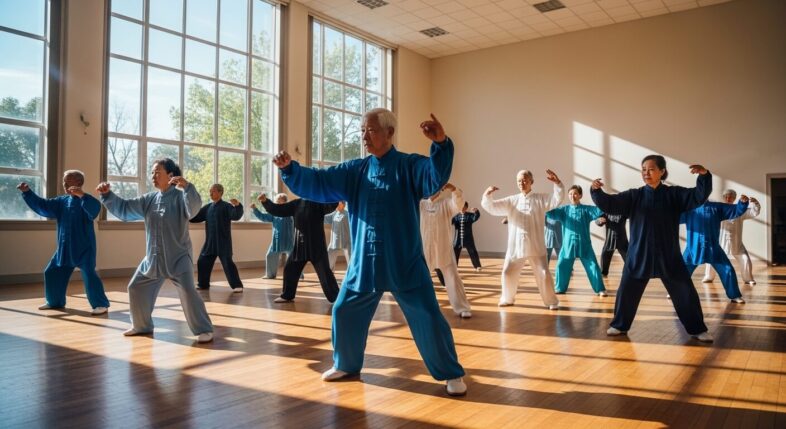
According to an article titled ‘The health benefits of tai chi’ published on the Harvard Health website, tai chi exercises are ideal for seniors because they utilize slow, low-impact, flowing movements that improve balance, flexibility, strength, and brain health while reducing fall risk, joint pain, and stress. It uses slow, circular movements that avoid forcing joints into their full range of motion, which can cause injuries, while keeping muscles relaxed and avoiding excessive stretching of connective tissue. Also as you move, you breathe deeply and naturally, promoting relaxation and reducing inflammation.
Below, I break down every movement, the order I recommend practicing them in, and how to build a sustainable routine — whether you’re standing, seated, or working with limited mobility. This comprehensive guide covers more than 10 tai chi exercises specifically adapted for older adults, including standing movements, seated chair tai chi exercise variations for elderly adults with mobility issues, and progressive techniques for all fitness levels and age ranges, from those in their 50s through their 80s and beyond.
The Health Benefits of Tai Chi for Seniors
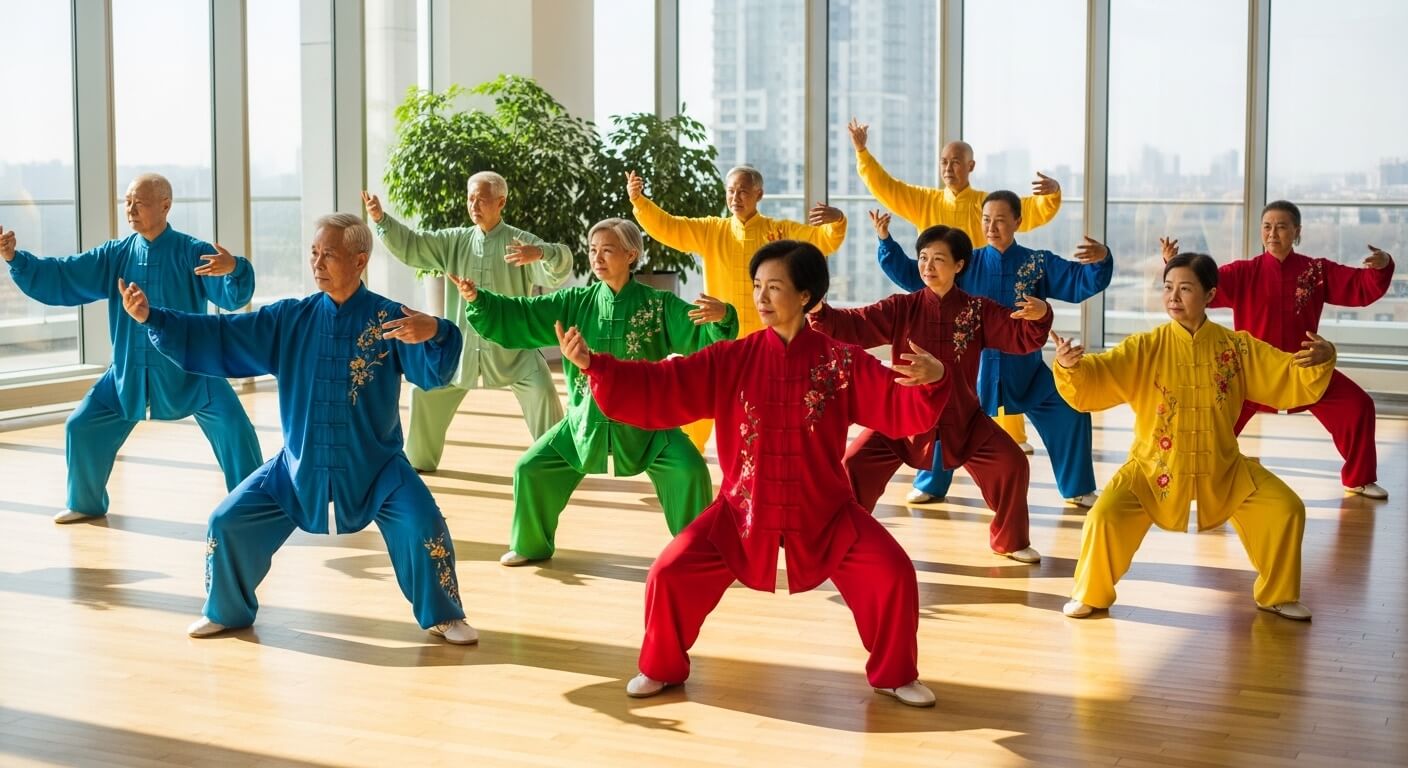
Tai chi originated in ancient China as a martial art emphasizing controlled movement and inner balance. Modern adaptations have transformed it into a therapeutic mind-body exercise that's particularly beneficial for older adults.
Physical Benefits
Balance and fall prevention: Tai chi strengthens the legs and improves proprioception (your body's sense of position in space). Seniors practicing twice weekly reduce their fall risk by 43-47%.
An article published in the Journal of the American Geriatrics Society showed that Tai Chi practice reduced the rate of falls in seniors by 43% after less than 12 months and by 13% after more than 12 months.
Another study published in 2018 in JAMA Internal Medicine showed that Tai Chi reduced falls in older adults at high risk by 58% compared to traditional stretching exercises.
Data evaluated from 28 randomized controlled trials from research databases including Web of Science, PubMed, Cochrane Central, and EBSCO found significant improvements in balance for seniors who practiced tai chi for 45 minutes twice a week for about 12 weeks.
Joint health: The gentle compression and movement during tai chi stimulates synovial fluid production, which acts as a natural joint lubricant, reducing friction and pain. These exercises will also strengthen the muscles that support the joints which provides better joint stability. Arthritis patients report 30-40% less pain after three months of tai chi practice.
Muscle strength: Despite appearing gentle, tai chi builds lower body strength comparable to resistance training, thanks to the sustained muscle engagement of the bent-knee stance.
Cardiovascular health: A 30-minute tai chi session raises heart rate to 50-60% of maximum capacity, providing moderate aerobic exercise that lowers blood pressure by an average of 7-10 points.
Mental and Cognitive Benefits
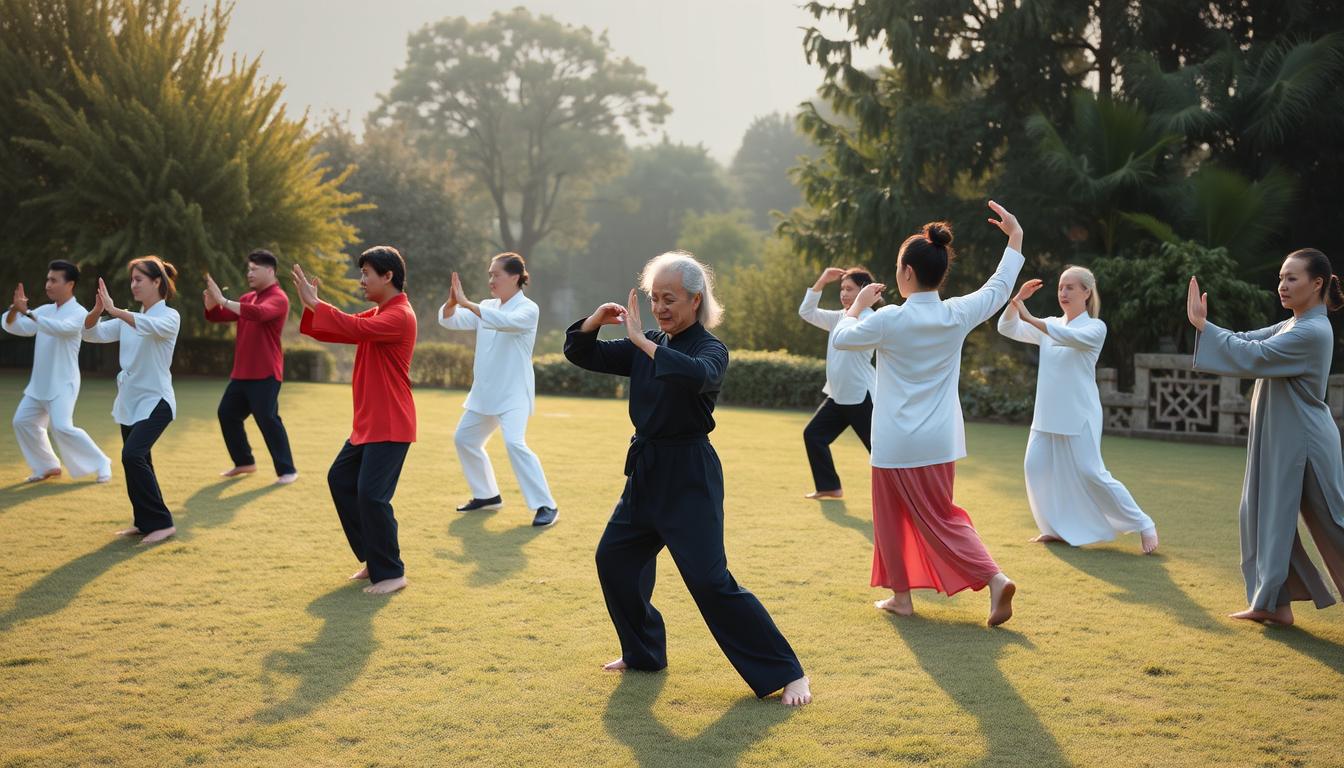
Better cognitive function: Seniors practicing tai chi show improved executive function, memory, and processing speed, with brain scans revealing increased gray matter volume in regions responsible for memory and learning.
Stress reduction: Tai chi lowers cortisol levels by 20-30% after a single session while simultaneously boosting the release of natural mood-enhancing and pain-relieving endorphins. Regular practitioners report significant decreases in anxiety and depression symptoms.
Improve sleep quality: 65% of seniors with insomnia who practice tai chi fall asleep faster and sleep 48 minutes longer on average.
Coordinating Breath with Tai Chi Movements
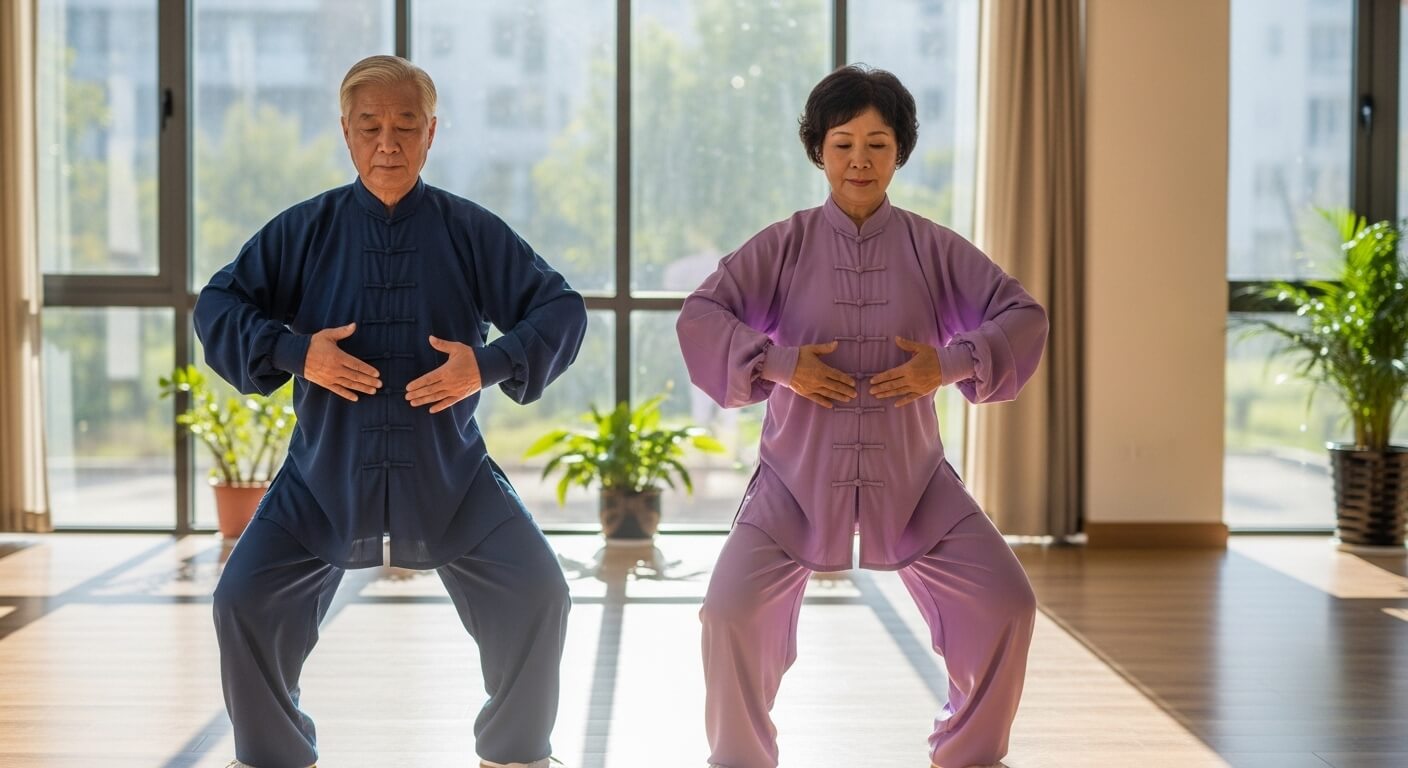
Proper breathing enhances the physical benefits of movement. It also promotes relaxation and mental clarity.
Breath coordination transforms tai chi from simple movement into a powerful mind-body practice. The breathing pattern follows a natural principle: inhale during gathering, lifting, or defensive movements, and exhale during extending, lowering, or pushing actions.
Natural Breathing Fundamentals
Your breath should never feel forced or strained during tai chi practice. Breathe through your nose when possible, allowing your diaphragm to expand your belly on the inhale and contract on the exhale. This diaphragmatic breathing activates the parasympathetic nervous system, reducing stress and lowering blood pressure by 7-10 points on average. Also called "belly breathing," this technique maximizes oxygen intake.
Key breathing characteristics:
- Each breath cycle lasts 4-6 seconds
- Matches the slow tempo of tai chi movements
- Feels effortless and natural throughout
- If gasping or holding breath, slow down movements
Matching Breath to Movement Patterns
Inhale When You:
- Raise your arms upward
- Shift weight backward
- Gather energy toward your center
- Open your chest or expand your body
Exhale When You:
- Lower your arms downward
- Shift weight forward
- Extend arms away from your body
- Push, press, or release energy
What Equipment and Clothing Do You Need for Tai Chi?
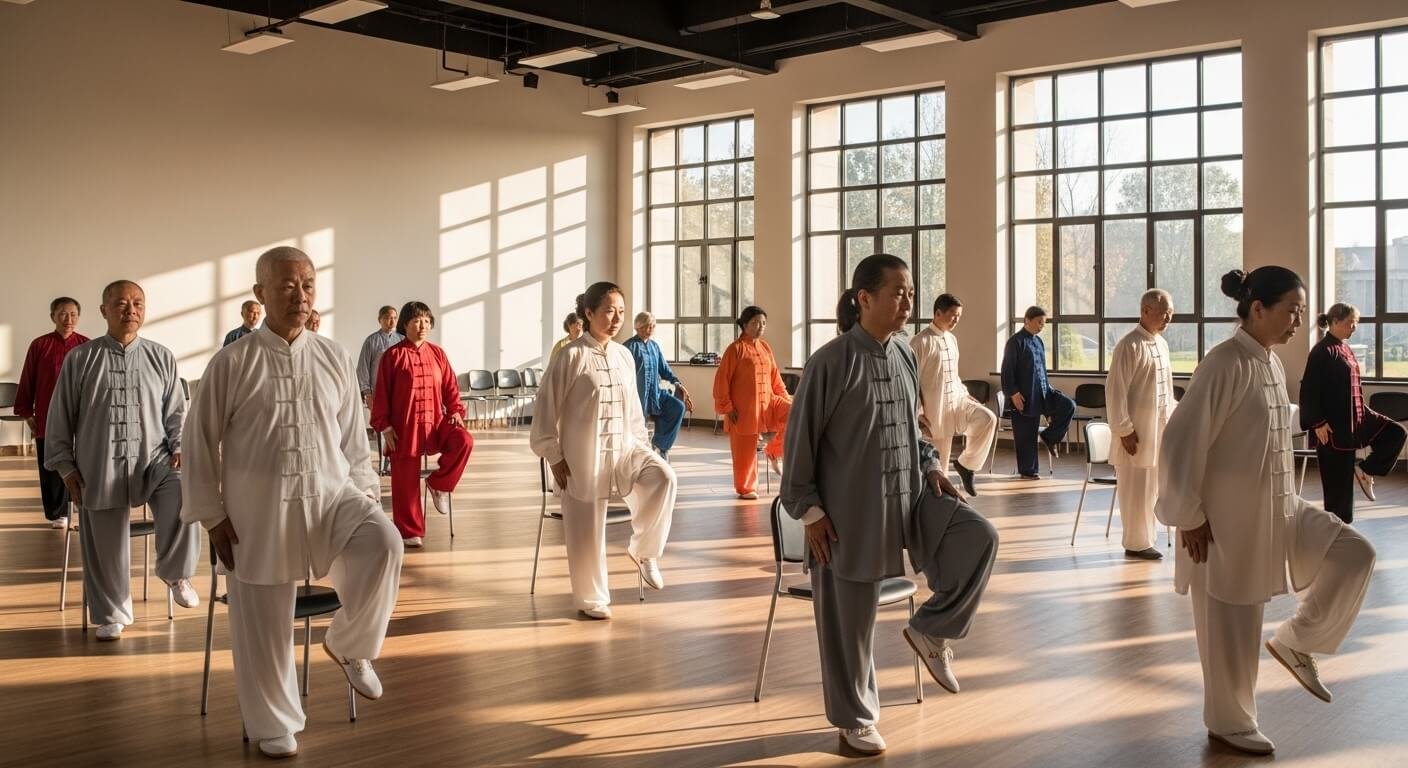
You need almost nothing to start tai chi — flat, flexible-soled shoes and loose, comfortable clothing are really the only requirements. That's the beauty of it.
What to wear:
- Flat-soled shoes with good grip — running shoes with thick, cushioned soles actually work against you here, since you need to feel the ground.
- Loose-fitting bottoms — sweatpants, yoga pants, anything that lets you drop into a low stance without restriction.
- Breathable top — long sleeves are fine, tight compression gear isn't necessary.
Optional but nice to have:
- A yoga mat or non-slip rug if practicing on hardwood or tile.
- A sturdy chair nearby (even for standing practice) in case you need a balance check.
- A water bottle — sessions run 20-45 minutes and you'll want it.
Safety Considerations Before Starting Tai Chi
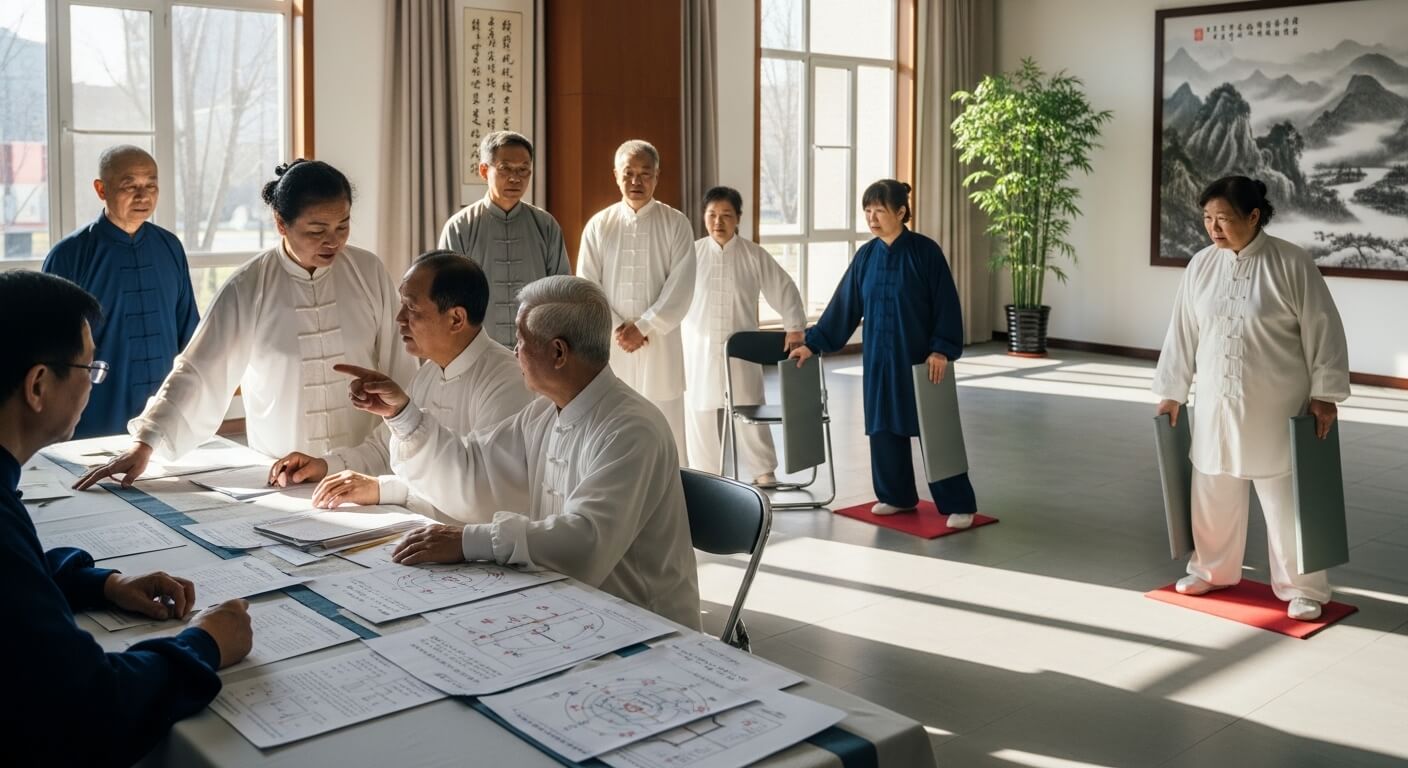
Talk to your doctor before starting tai chi if you have a heart condition, joint replacement, severe osteoporosis, or a recent injury, since a few modifications may be needed. For most seniors, though, tai chi is considered one of the safest exercise forms out there.
Before you start:
- Check with your physician if you have cardiovascular issues, recent surgeries, or balance disorders like vertigo.
- Warm up first — even 3-5 minutes of gentle arm circles and ankle rolls.
- Keep a chair or wall nearby during your first few sessions, just in case.
- Wear the right footwear (see above) — slipping is the #1 preventable risk.
- Practice on a flat, uncluttered surface — clear the rugs, cords, and pets out of the way.
Stop and rest if you experience:
- Sharp or shooting pain (mild muscle fatigue is normal, sharp pain isn't)
- Dizziness or lightheadedness
- Chest tightness or shortness of breath
- Joint pain that worsens rather than eases
Proper Exercise Order for Tai Chi Practice
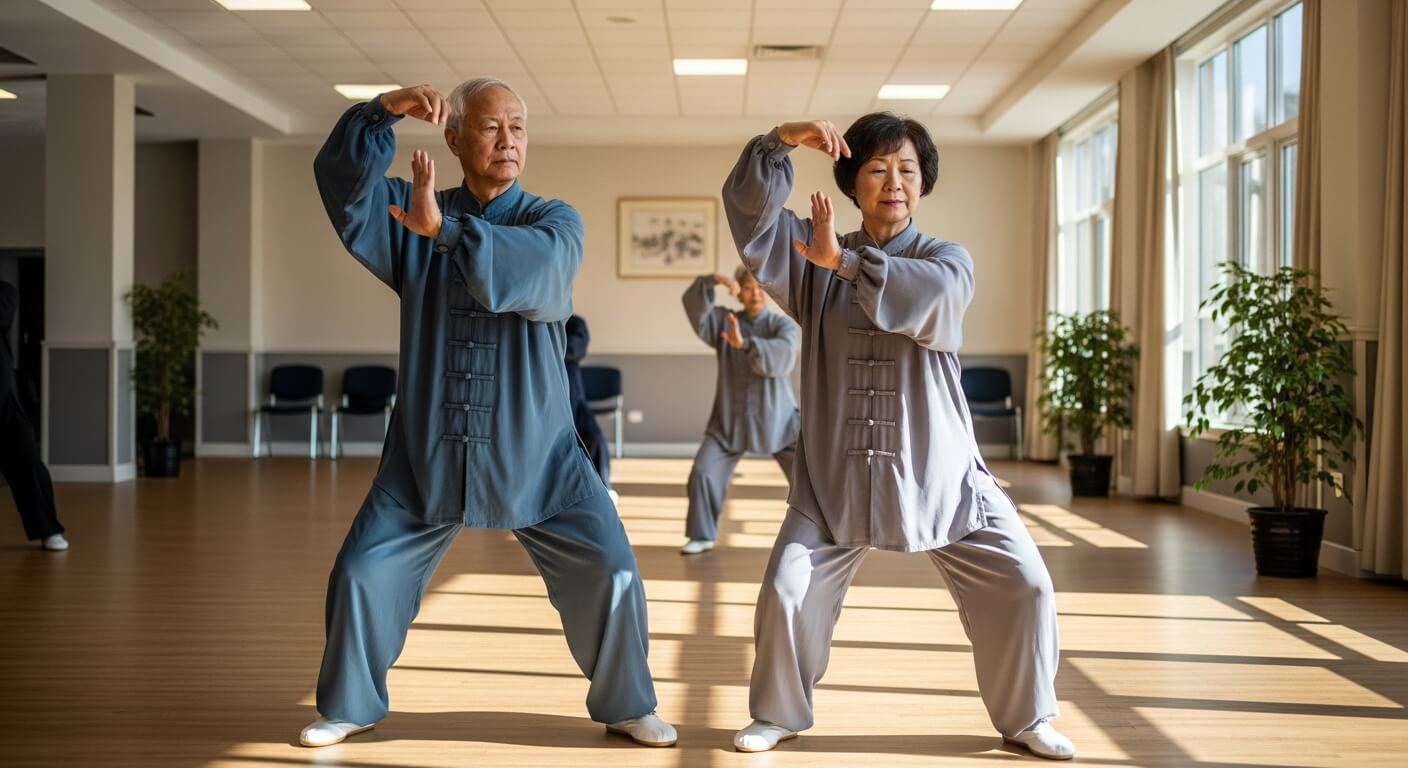
I structure a tai chi session in a specific sequence — starting with grounding and balance work, moving into flowing full-body forms, and finishing with a calming closing posture — because this order safely builds intensity and protects against injury.
| Exercise Name | Best For | Benefits |
|---|---|---|
| Standing Meditation | Beginners | Grounds the body, calms the nervous system, teaches weight distribution |
| Torso Twists | Spinal Mobility | Loosens the spine, improves rotational range of motion |
| Empty Stance | Balance Retraining | Strengthens stabilizer muscles, retrains single-leg balance |
| Tai Chi Walking | Everyday Mobility | Improves gait, coordination, and walking confidence |
| Golden Rooster Stance | Single-Leg Strength | Builds leg strength and proprioception |
| Parting the Wild Horse's Mane | Full-Body Coordination | Integrates upper and lower body movement patterns |
| Brush Knee and Twist Step | Lower Fall Risk | Trains weight shifting and lower-body control |
| White Crane Spreads Its Wings | Posture | Opens the chest and strengthens postural muscles |
| Grasp Sparrow's Tail | Building Stamina | Builds cardiovascular endurance through continuous flow |
| Single Whip | Shoulder Flexibility | Increases shoulder range of motion |
| Wave Hands Like Clouds | Core Strength | Engages obliques and deep core stabilizers |
| High Pat on Horse | Overhead Reach | Improves shoulder elevation and arm extension |
| Repulse the Monkey | Backward Balance | Trains balance while moving backward |
| Fair Lady Works at Shuttles | Multidirectional Coordination | Builds coordination across multiple directions |
| Needle at Sea Bottom | Spinal Health | Stretches and strengthens the lower back |
| Cross Hands | Transitions | Resets the body and connects movement sequences |
| Carry Tiger to the Mountain | Strength Building | Builds functional lower and upper body strength |
| Closing Form (Return to Wu Chi) | Recovery and Calm | Lowers heart rate and closes the nervous system down gently |
Standing Meditation — Best for Beginners
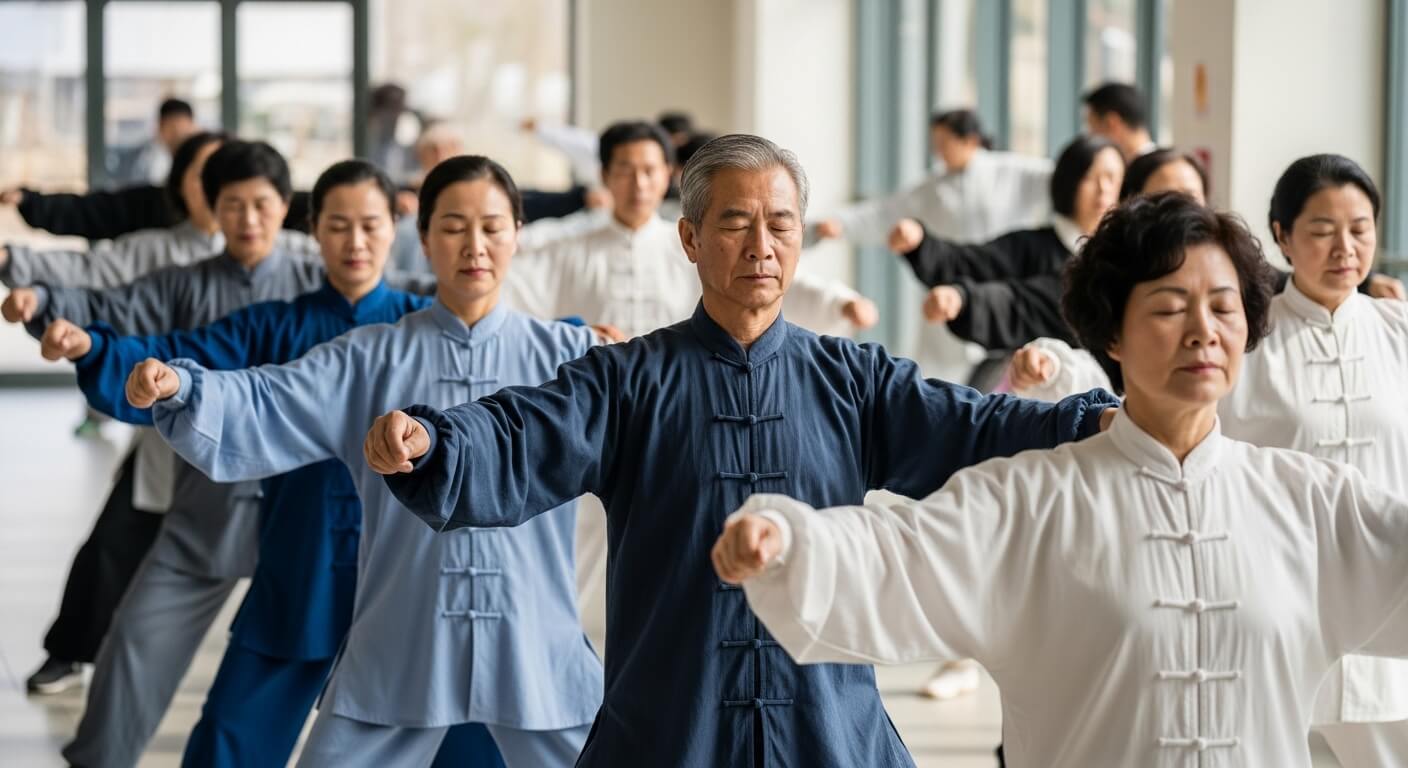
I rank Standing Meditation as the #1 exercise for beginners because it requires no memorized sequence, builds body awareness, and teaches the weight-shifting foundation used in the three main parts of Tai Chi.
Benefits: Grounds the body, improves posture awareness, calms the nervous system, and builds the foundational stance used in every other form.
Instructions:
- Stand with feet shoulder-width apart, knees slightly bent (inhale as you settle into position, 4 seconds).
- Relax your arms at your sides, shoulders down and soft (exhale fully, 4 seconds).
- Shift your weight slightly forward and back to find your center (inhale on forward shift, exhale on backward shift).
- Hold the centered position for 1–2 minutes, breathing slowly through the nose — inhale for 5 seconds, exhale for 5 seconds.
- Release by gently shaking out your hands and feet.
Torso Twists — Best for Spinal Mobility
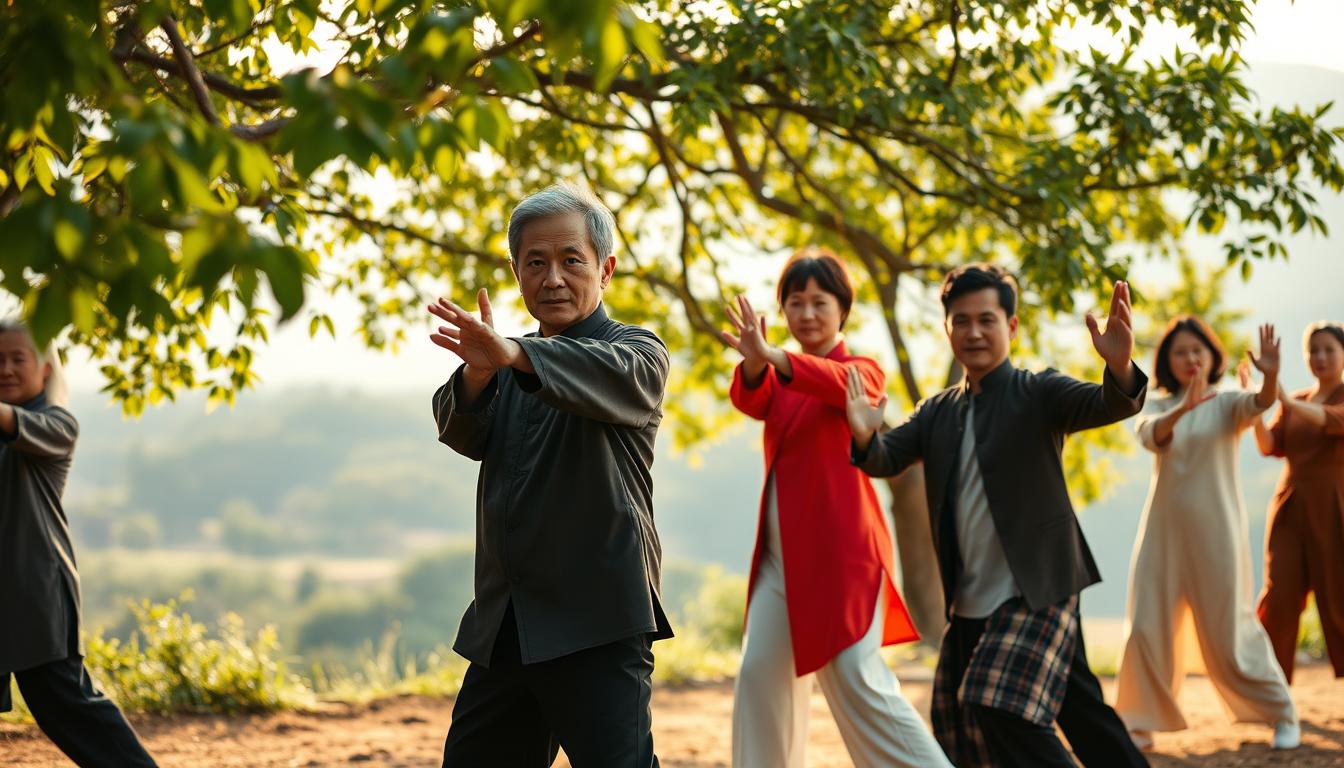
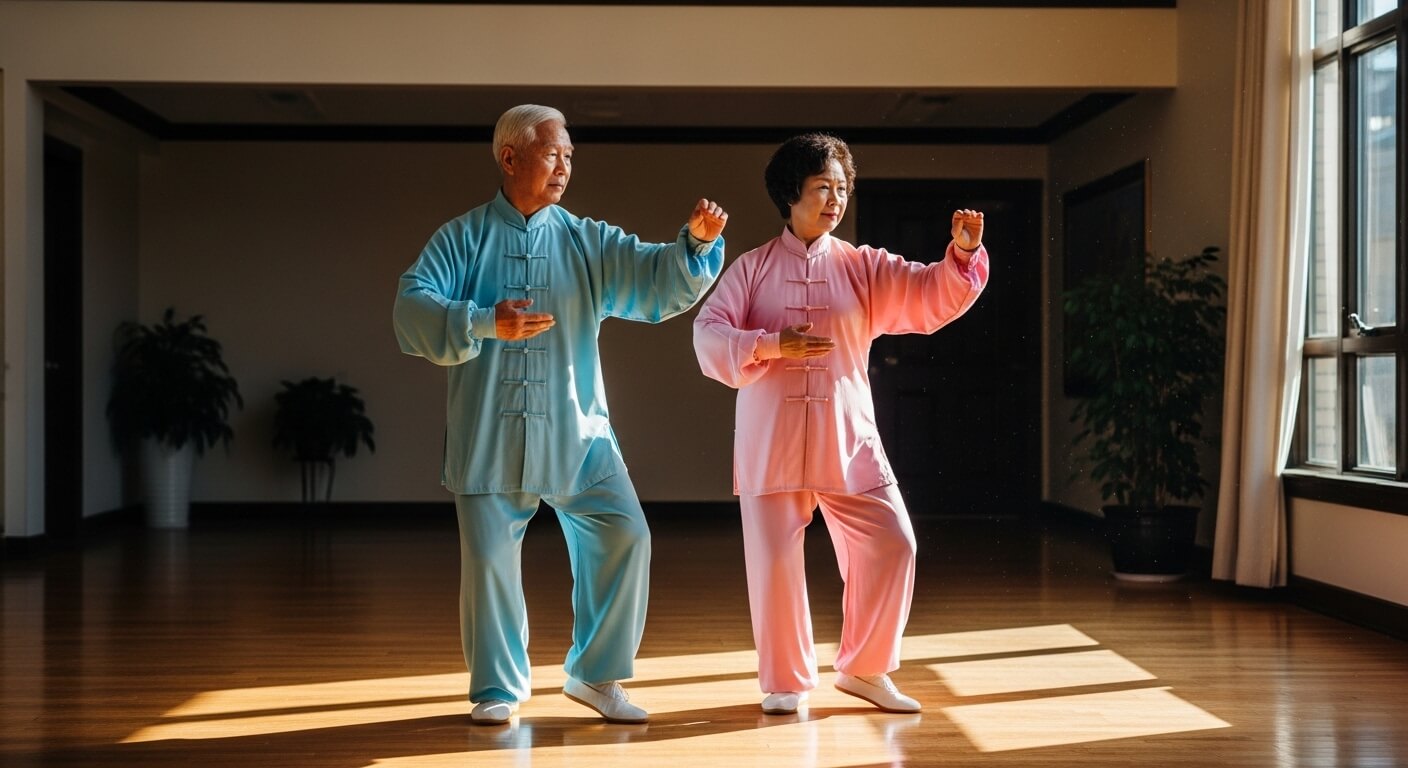
I recommend Torso Twists as the #2 exercise because they directly target spinal rotation, a range of motion that naturally declines with age and affects everyday tasks like looking over your shoulder while driving.
Benefits: Loosens the spine, improves rotational flexibility, and releases tension in the mid- and lower back.
Instructions:
- Stand with feet shoulder-width apart, knees soft, arms relaxed (inhale to prepare, 3 seconds).
- Rotate your torso gently to the right, letting your arms swing naturally (exhale as you twist, 4 seconds).
- Return to center (inhale, 3 seconds).
- Rotate to the left (exhale, 4 seconds).
- Repeat for 8–10 cycles per side, keeping hips relatively stationary.
Empty Stance — Best for Balance Retraining
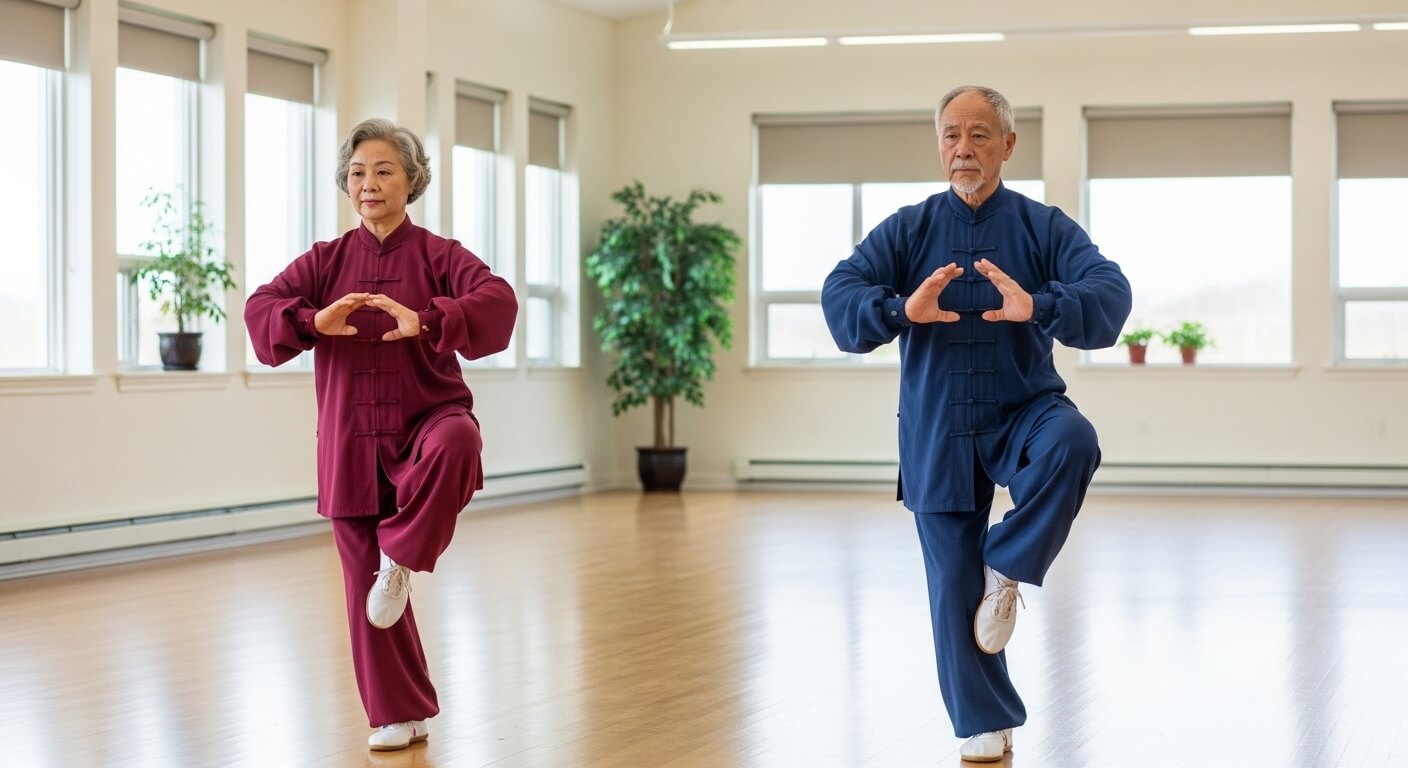
I place Empty Stance at #3 because it isolates single-leg weight-bearing in a controlled, low-risk way, making it one of the most effective balance-retraining exercises for seniors with fall concerns.
Benefits: Strengthens stabilizer muscles in the ankles and hips, retrains single-leg balance, and supports fall prevention.
Instructions:
- Shift 90% of your weight onto your right leg, keeping the knee soft (inhale, 4 seconds).
- Touch your left toe lightly to the floor in front of you, heel lifted (exhale, 4 seconds).
- Hold the position for 10–15 seconds, breathing steadily.
- Return your left foot to a full stance (inhale, 3 seconds).
- Switch sides and repeat, aiming for 4–6 repetitions per leg.
Tai Chi Walking — Best for Everyday Mobility
I recommend Tai Chi Walking as the #4 exercise because it translates almost directly into safer, more confident everyday walking — the single most functional benefit on this list.
Benefits: Improves gait pattern, walking confidence, and coordination between the upper and lower body.
Instructions:
- Shift your weight fully onto your back leg (exhale, 3 seconds).
- Lift your front foot and step forward slowly, heel touching down first (inhale, 4 seconds).
- Roll your weight forward onto the full foot (exhale, 4 seconds).
- Pause briefly before lifting the back foot to step again.
- Continue for 8–10 steps forward, then reverse direction.
Golden Rooster Stance — Best for Single-Leg Strength
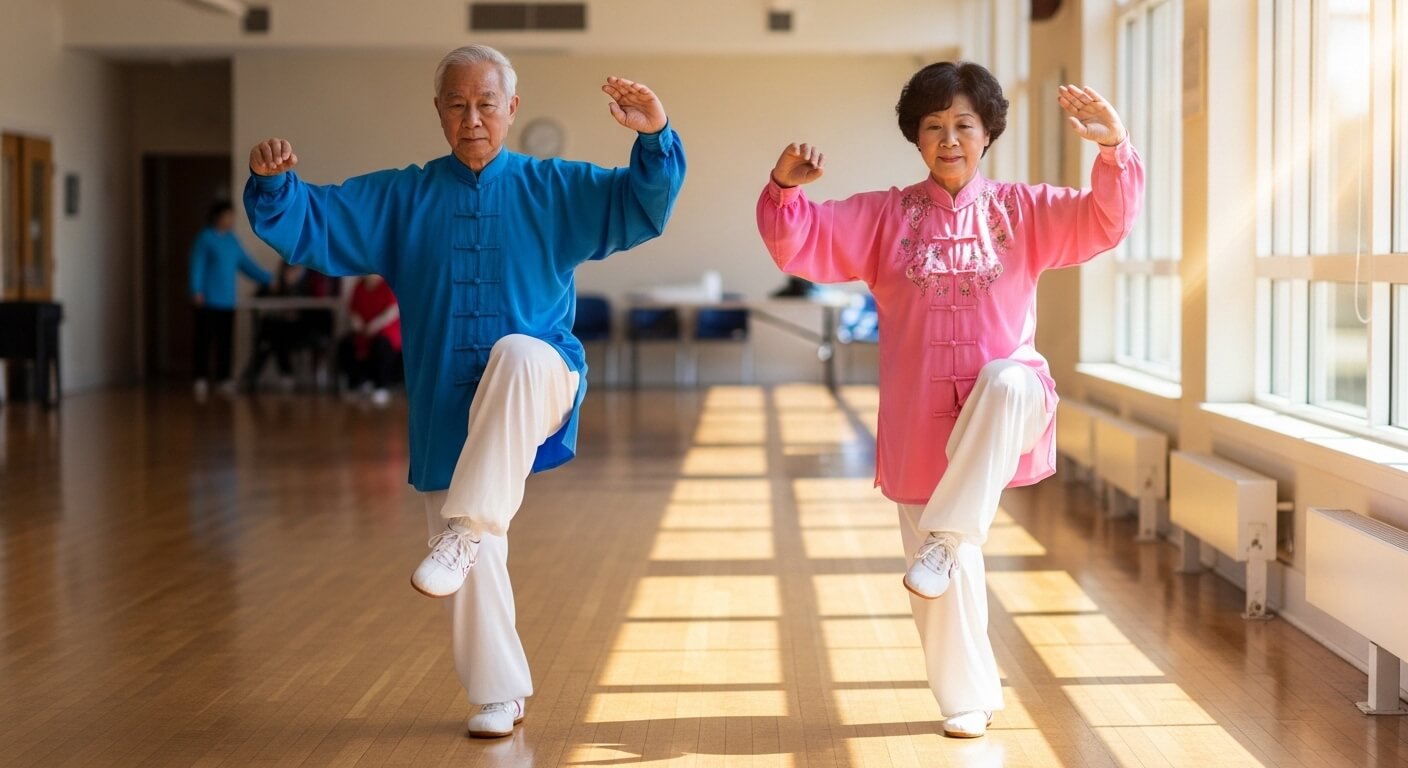
I rank Golden Rooster Stance #5 because it builds real single-leg strength — a stronger form of balance training than static poses alone, and a strong predictor of fall resistance in older adults.
Benefits: Builds single-leg strength, improves hip stability, and enhances proprioception.
Instructions:
- Shift your weight fully onto your left leg (inhale, 4 seconds).
- Lift your right knee to hip height, foot relaxed (exhale, 4 seconds).
- Raise your right arm overhead, left hand at your side (continue exhaling).
- Hold for 5–10 seconds, breathing evenly.
- Lower slowly (inhale, 3 seconds) and switch legs.
Parting the Wild Horse's Mane — Best for Full-Body Coordination
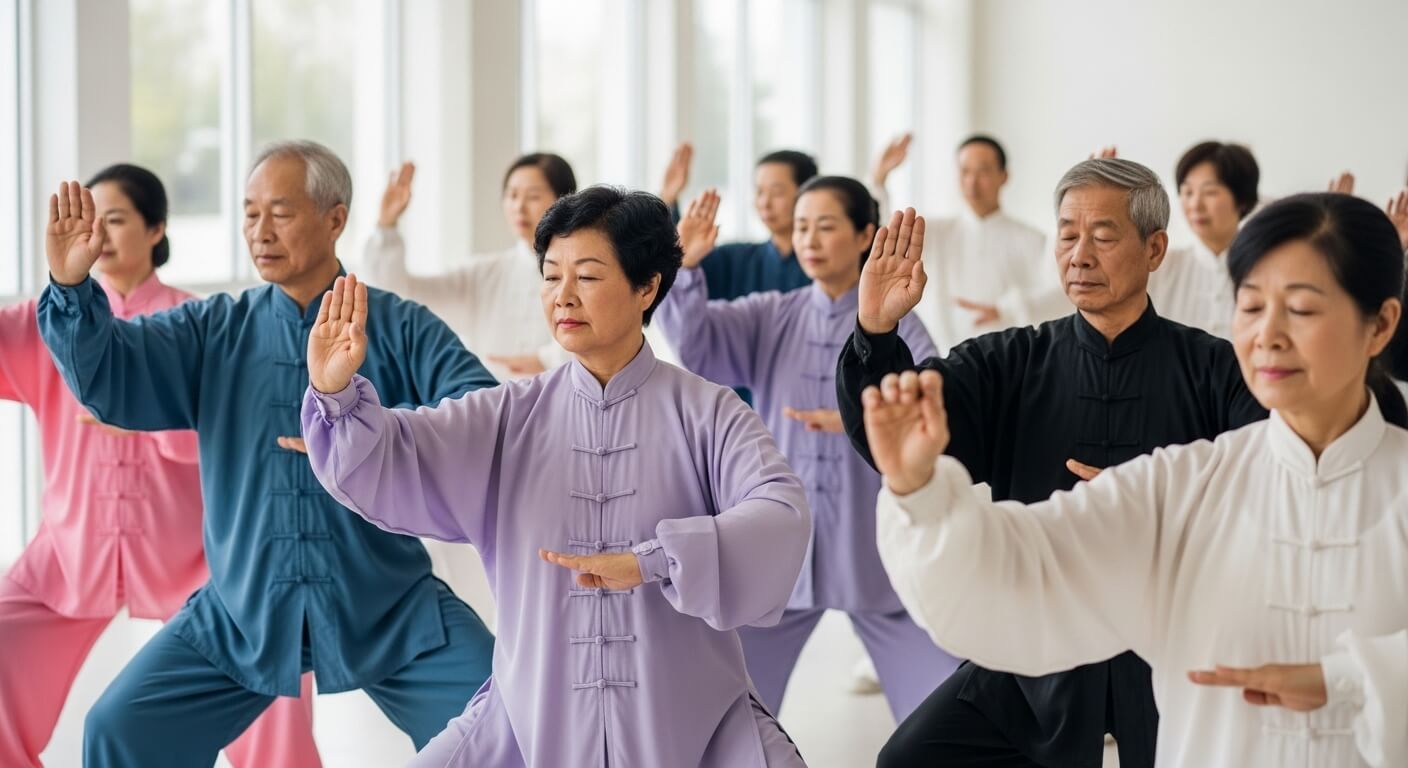
I place this form at #6 because it's one of the few tai chi movements that fully integrates arm, leg, and torso coordination into a single flowing motion.
Benefits: Improves full-body coordination, strengthens legs, and opens the chest and shoulders.
Instructions:
- Shift weight onto your right leg, holding an imaginary ball at chest height (inhale, 4 seconds).
- Step forward with your left foot, bending the knee (continue inhaling).
- Separate your hands diagonally — one rising to eye level, one lowering to hip level (exhale, 5 seconds).
- Shift weight fully into the front leg as arms complete the separation.
- Repeat on the opposite side, alternating for 6–8 total repetitions.
Brush Knee and Twist Step — Best for Lower Fall Risk
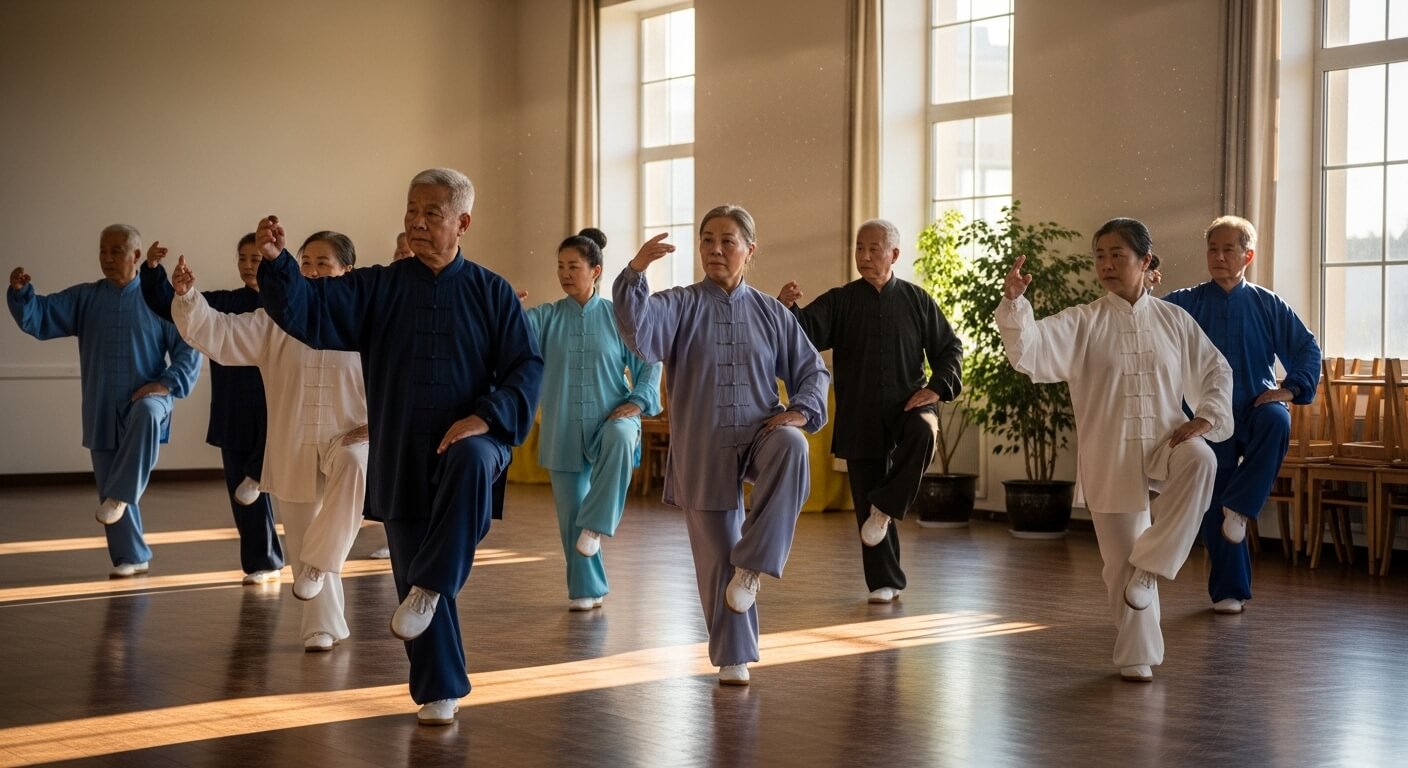
I rank this movement #7 because it directly trains the weight-shifting and knee-clearing mechanics tied to lower fall risk in clinical fall-prevention research.
Benefits: Improves weight-shifting control, strengthens the legs, and supports lower fall risk.
Instructions:
- Shift weight onto your back leg, one hand raised near your ear (inhale, 4 seconds).
- Step forward with the opposite foot (continue inhaling).
- Brush your hand past your knee as you shift weight forward (exhale, 4 seconds).
- Push your other hand forward at chest height as the step completes.
- Alternate sides for 6–8 repetitions.
White Crane Spreads Its Wings — Best for Posture
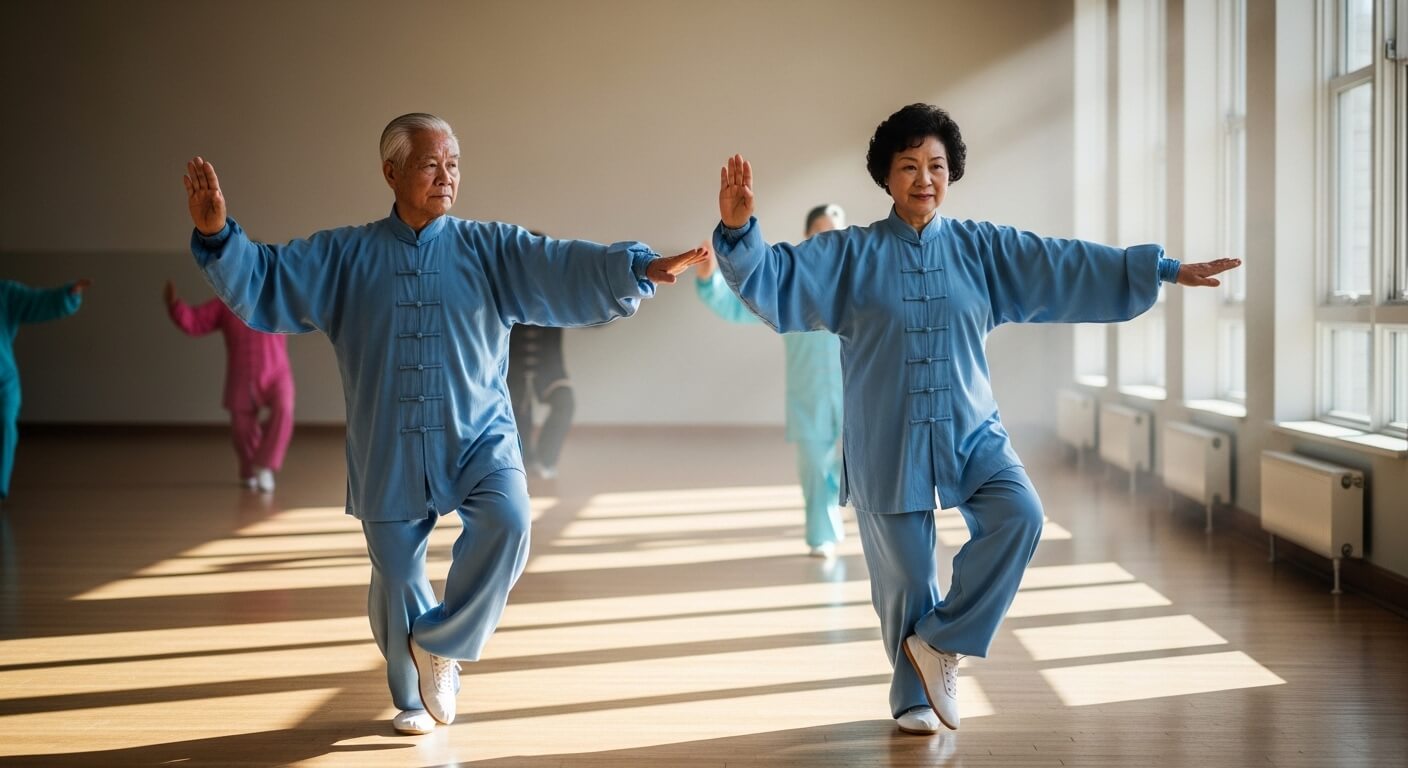
I place this form at #8 because the wide arm-opening motion directly counteracts the forward-rounded posture common in older adults.
Benefits: Opens the chest, strengthens postural muscles, and improves upright alignment.
Instructions:
- Stand in a narrow stance, hands crossed at chest height (inhale, 4 seconds).
- Raise your right hand above your head, palm facing out (exhale, 4 seconds).
- Lower your left hand toward your hip, palm facing down (continue exhaling).
- Hold the expanded position for 3–5 seconds, breathing normally.
- Return to center (inhale, 3 seconds) and repeat 4–6 times.
Grasp Sparrow's Tail — Best for Building Stamina
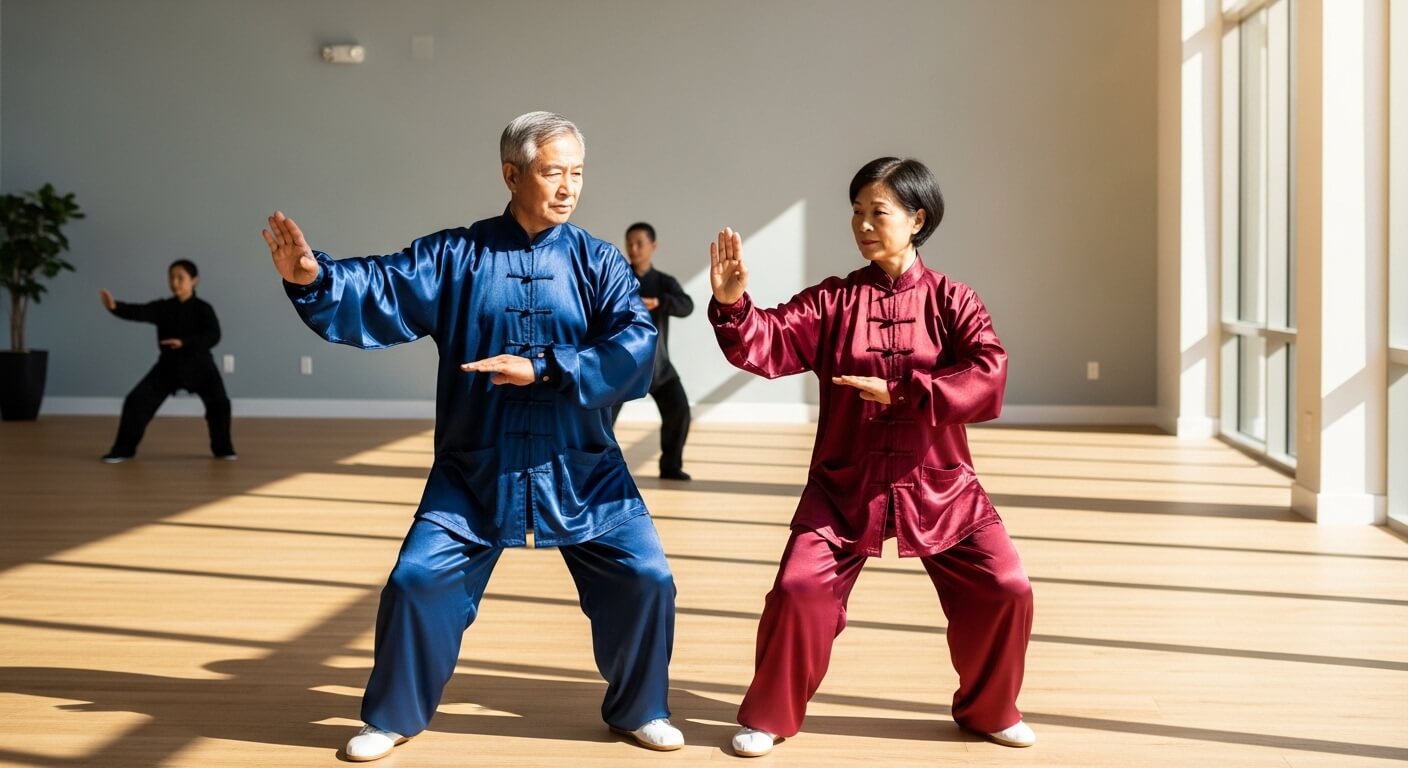
I rank this form #9 because its four connected sub-movements create a longer, continuous flow that builds cardiovascular endurance more than shorter, static poses.
Benefits: Builds stamina, improves coordination, and strengthens the legs through continuous movement.
Instructions:
- Ward off — shift weight forward, arm rising to chest height (inhale, 4 seconds).
- Roll back — shift weight back, arms drawing down and in (exhale, 4 seconds).
- Press — shift weight forward, hands pressing outward (inhale, 4 seconds).
- Push — shift weight forward again, hands pushing forward (exhale, 4 seconds).
- Repeat the full four-part sequence 4–6 times.
Single Whip — Best for Shoulder Flexibility
I place Single Whip at #10 because its wide, hooked-hand extension actively stretches the shoulder joint through a fuller range of motion than most other forms.
Benefits: Increases shoulder flexibility, improves upper-body coordination, and stretches the chest.
Instructions:
- Gather your hands together in front of your chest (inhale, 4 seconds).
- Extend your right arm out to the side, hand forming a hook shape (exhale, 4 seconds).
- Step left foot out and shift weight into it (continue exhaling).
- Push your left palm forward at chest height as the stance settles.
- Hold briefly, then reset and repeat 4–6 times, alternating sides.
Wave Hands Like Clouds — Best for Core Strength
I rank this movement #11 because the continuous side-to-side torso rotation engages the obliques and deep core stabilizers more than any other form in the sequence.
Benefits: Strengthens the core, improves lateral balance, and enhances spinal rotation.
Instructions:
- Shift weight onto your right leg, hands positioned in front of your torso (inhale, 4 seconds).
- Rotate your torso and arms to the left as weight shifts left (exhale, 4 seconds).
- Step your right foot next to your left, adjusting stance.
- Rotate back to the right as weight shifts right (inhale, 4 seconds).
- Continue the side-stepping wave pattern for 8–10 cycles.
High Pat on Horse — Best for Overhead Reach
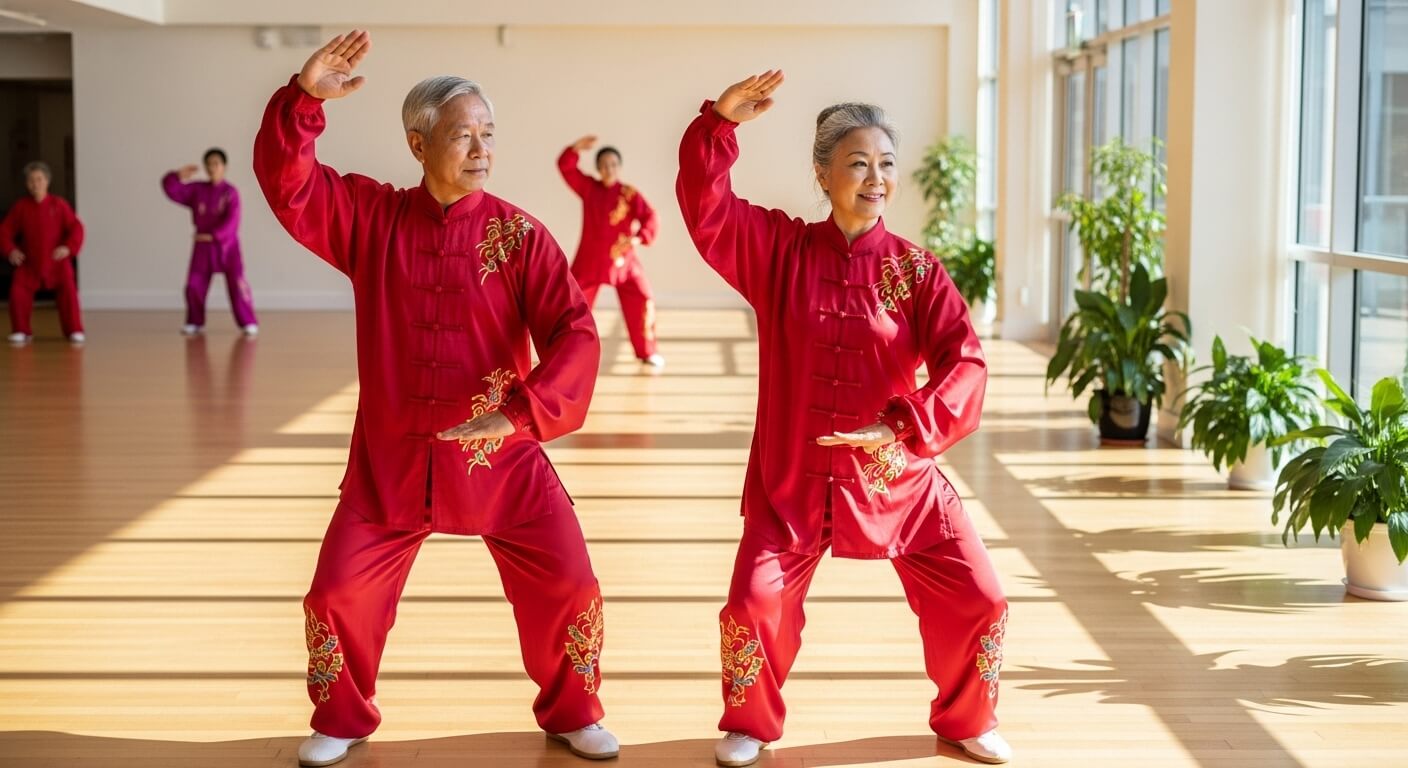
I place this form at #12 because its overhead arm extension specifically trains shoulder elevation, a movement pattern that becomes limited with age.
Benefits: Improves overhead reach, shoulder flexibility, and arm extension strength.
Instructions:
- Shift weight onto your back leg, hands at chest height (inhale, 4 seconds).
- Extend your front hand forward and slightly upward, palm up (exhale, 4 seconds).
- Draw your back hand toward your hip.
- Hold the extended reach for 2–3 seconds.
- Reset and repeat 4–6 times, alternating sides.
Repulse the Monkey — Best for Backward Balance
I rank this movement #13 because stepping backward with control is a much harder balance skill than stepping forward, making it valuable specifically for backward balance training.
Benefits: Trains backward balance, strengthens the legs, and improves coordination during retreat movements.
Instructions:
- Stand with one arm extended forward, one hand near your hip (inhale, 4 seconds).
- Step backward with your front foot, shifting weight onto it (exhale, 4 seconds).
- Draw your front hand back toward your hip as the other extends forward.
- Complete the weight shift fully onto the back leg.
- Alternate sides for 6–8 repetitions.
Fair Lady Works at Shuttles — Best for Multidirectional Coordination
I place this form at #14 because it requires simultaneous diagonal stepping and arm rotation, demanding more spatial coordination than any earlier form in the sequence.
Benefits: Builds multidirectional coordination, improves footwork, and strengthens the shoulders.
Instructions:
- Turn your torso diagonally, hands gathered at chest height (inhale, 4 seconds).
- Step diagonally forward with the corresponding foot (continue inhaling).
- Raise one hand overhead as a shield while the other pushes forward (exhale, 5 seconds).
- Shift weight fully into the diagonal stance.
- Repeat toward each of the four corners, 1–2 repetitions per direction.
Needle at Sea Bottom — Best for Spinal Health
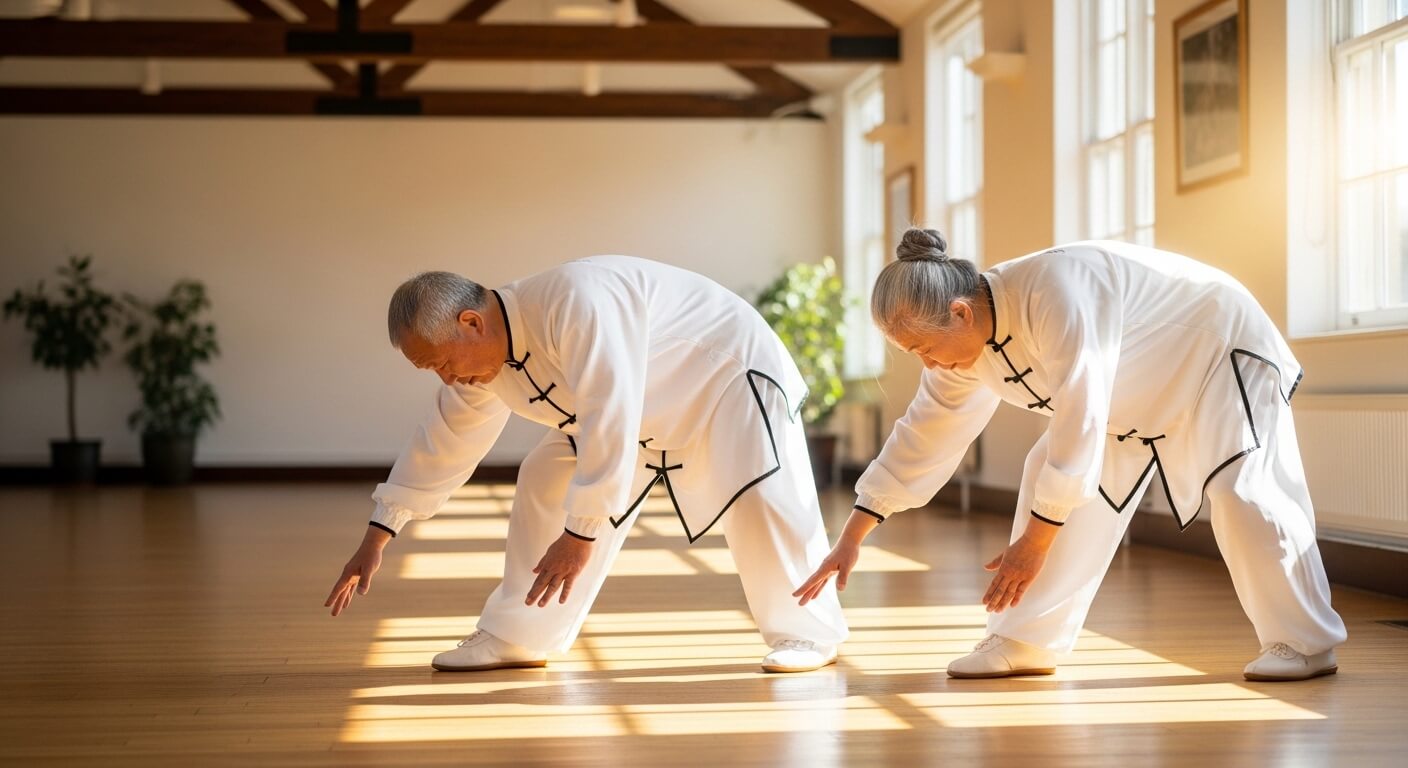
I rank this form #15 because its forward-bending, hand-lowering motion gently stretches and strengthens the lower back, supporting overall spinal health in aging bodies.
Benefits: Stretches the lower back, improves spinal flexibility, and supports overall spinal health.
Instructions:
- Stand with feet shoulder-width apart, one hand raised near your ear (inhale, 4 seconds).
- Lean slightly forward from the hips, guiding your other hand downward (exhale, 4 seconds).
- Hold the gentle forward lean for 2–3 seconds, keeping the spine long.
- Rise back to standing (inhale, 3 seconds).
- Repeat 4–6 times, alternating sides.
Cross Hands — Best for Transitions
I place Cross Hands at #16 because its role is to neutrally reset the body's alignment between forms, making it the best transitional movement for reducing strain when shifting from one posture to the next.
Benefits: Resets posture and alignment, reduces transitional strain, and calms breathing between forms.
Instructions:
- Shift weight evenly onto both feet, arms lowered (exhale, 4 seconds).
- Raise both arms in a wide arc, crossing them at the wrists in front of your chest (inhale, 4 seconds).
- Hold the crossed position for 2–3 seconds.
- Lower your arms slowly back to your sides (exhale, 4 seconds).
- Pause here for 3–5 breaths before continuing to the next form.
Carry Tiger to the Mountain — Best for Strength Building
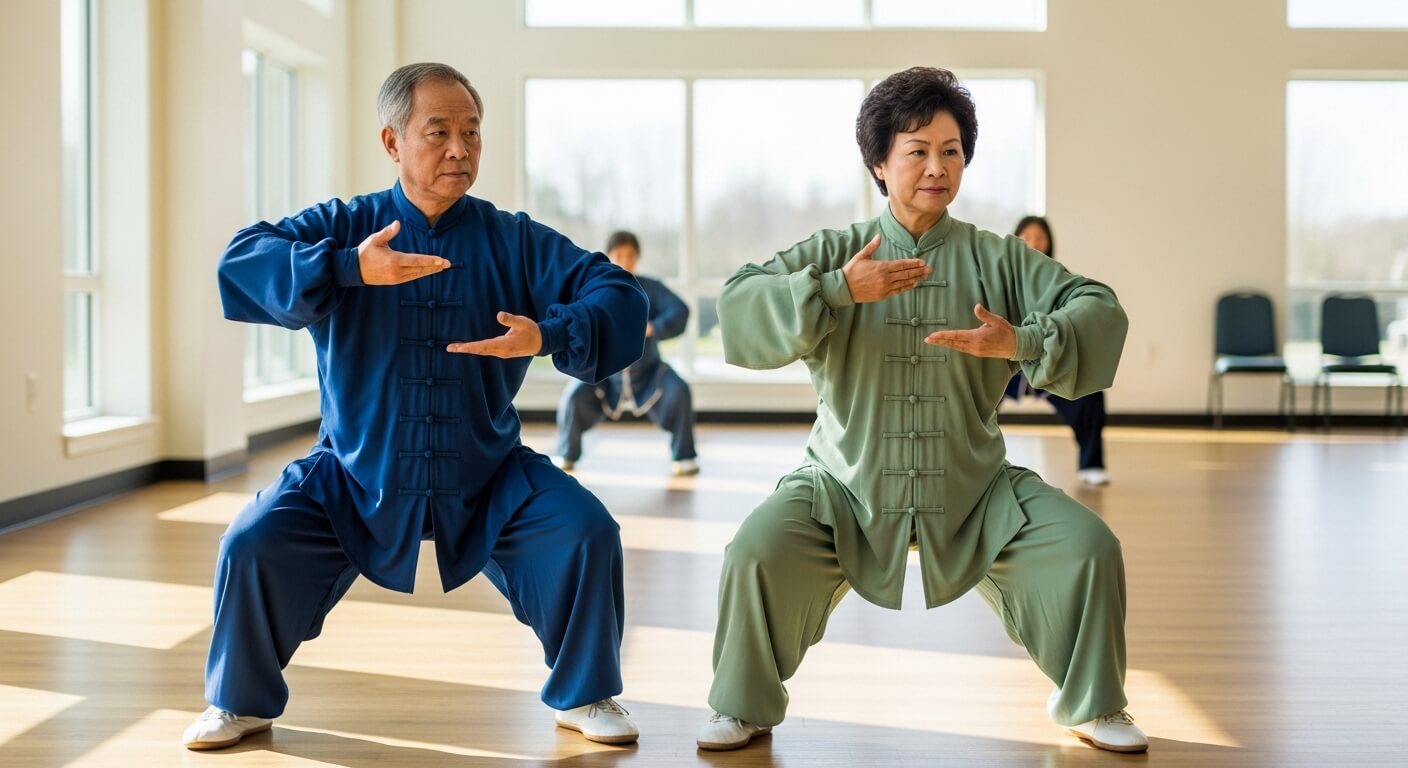
I rank this form #17 because its deep stance combined with a full-arm push generates more functional lower- and upper-body strength than earlier, lighter movements.
Benefits: Builds lower-body strength, engages the upper body, and improves overall functional strength.
Instructions:
- Turn your torso and step into a diagonal stance, hands gathering at your side (inhale, 4 seconds).
- Shift weight forward into the front leg as your hands press outward (exhale, 4 seconds).
- Push both palms forward at chest height, bending the front knee deeply.
- Hold the pushed position for 2–3 seconds.
- Reset and repeat 4–6 times, alternating sides.
Closing Form (Return to Wu Chi) — Best for Recovery and Calm
I place this final form at #18 because its purpose is entirely restorative — slowing the heart rate and breath back to baseline, which makes it the best possible way to end a session.
Benefits: Lowers heart rate, calms the nervous system, and signals recovery to the body after practice.
Instructions:
- Stand with feet together, arms relaxed at your sides (inhale, 5 seconds).
- Raise both arms slowly to chest height, palms facing down (continue inhaling, 5 seconds).
- Lower your arms gently back to your sides (exhale, 6 seconds).
- Stand quietly for 30–60 seconds, breathing naturally.
- Close your practice by gently shaking out your hands and feet.
12-Week Tai Chi Training Schedule for Beginner Seniors in Their 50s, 60s, or 70s
I structure this 12-week schedule in three progressive phases so beginners build balance and strength safely before adding more complex, multidirectional forms.
A beginner tai chi schedule should progress gradually from standing basics in weeks 1-4 to full flowing sequences by week 12, practicing 3-4 times per week for 20-30 minutes per session. Consistency beats intensity here, every time.
| Weeks | Focus | Exercises | Session Length |
|---|---|---|---|
| 1-2 | Foundations | Standing Meditation, Torso Twists, Empty Stance | 15-20 min |
| 3-4 | Weight shifting | Add Tai Chi Walking, Golden Rooster Stance | 20-25 min |
| 5-6 | First flowing forms | Add Parting the Wild Horse's Mane, Brush Knee and Twist Step | 25 min |
| 7-8 | Posture & stretch | Add White Crane Spreads Its Wings, Single Whip | 25-30 min |
| 9-10 | Building sequences | Add Grasp Sparrow's Tail, Wave Hands Like Clouds | 30 min |
| 11 | Advanced balance | Add Repulse the Monkey, Fair Lady Works at Shuttles | 30 min |
| 12 | Full integration | Full sequence, including Carry Tiger to the Mountain and Closing Form | 30-40 min |
A few notes on pacing:
- Don't rush the progression. If week 4 still feels shaky, stay there another week. No penalty for going slow.
- Three sessions a week is the sweet spot. More isn't necessarily better — recovery matters too.
- Reassess at week 6. If balance and stamina feel noticeably better, you're on track. If not, consider a class or instructor check-in.
Chair-Based Tai Chi Exercises for Seniors with Limited Mobility
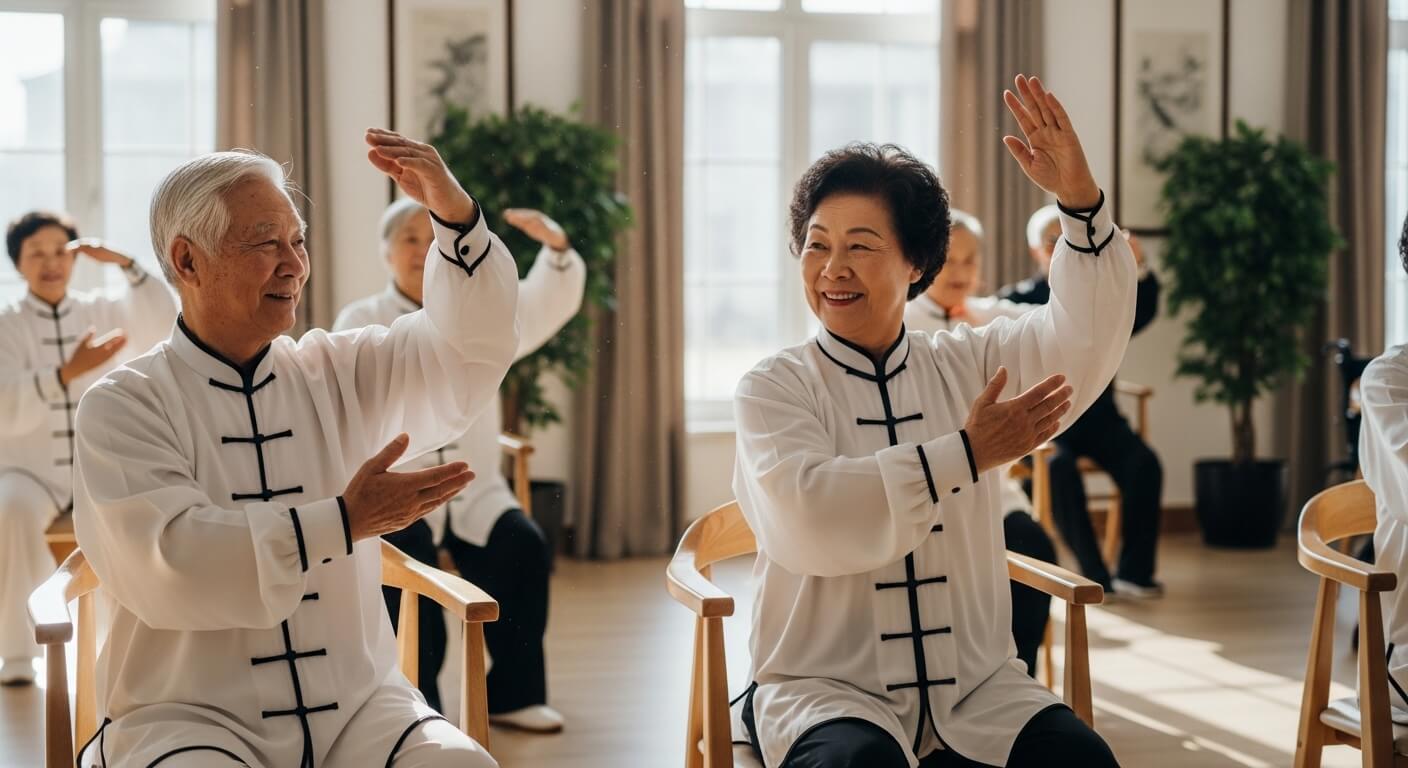
I recommend chair-based tai chi for seniors with significant balance impairment, joint pain, or recovery limitations because it preserves the breathing and movement benefits of standing tai chi while removing fall risk entirely.
Seated tai chi adapts the same weight-shift, breath, and arm movements to a chair, giving seniors with limited mobility or balance concerns full access to tai chi's benefits without any standing risk. You lose zero benefit sitting down for these — just adapt the mechanics.
Benefits of Chair-Based Tai Chi
- Preserves shoulder and arm engagement since seated sweeping motions still fully activate the deltoids and upper back.
- Keeps core muscles working through seated rotation, without any standing-balance risk.
- Maintains breath-movement coordination, which is where most of the stress-relief and cognitive benefit actually comes from.
- Improves seated posture and spinal alignment over time, useful for anyone who spends a lot of the day sitting anyway.
- Removes the fall-risk barrier entirely, so people who'd otherwise skip exercise altogether can still participate.
| Standing Version Loses | Seated Version Keeps |
|---|---|
| Full leg-strengthening benefit | Arm, shoulder, and core engagement |
| Balance training | Breath-movement coordination |
| Weight-shift practice | Range-of-motion for shoulders and spine |
| — | Full cognitive and stress-relief benefits |
Chair Setup Tips:
- Use a sturdy, armless chair so arms can move freely
- Keep feet flat on the floor, hip-width apart
- Sit toward the front edge of the chair for better posture and range of motion
Essential Chair Tai Chi Exercises
Seated Wave Hands Like Clouds
Benefits: Engages the obliques, Loosens shoulder joints, and improves seated spinal mobility
How to do it:
- Sit tall, feet flat on the floor, hands resting at waist height — inhale as you rotate your torso to the right.
- Exhale as you sweep your left hand up and across your body while your right hand sweeps down toward your hip.
- Inhale as you rotate back through center toward the left side.
- Exhale as you reverse the hand positions, sweeping right hand up and left hand down.
- Continue the alternating sweep for 8-10 full cycles.
Seated Parting the Wild Horse's Mane
Benefits: Strengthens the shoulders and upper back, engages the core, and improves upper-body coordination.
How to do it:
- Sit tall with feet flat, holding an imaginary ball at your chest — inhale as you shift weight slightly onto your right hip.
- Exhale as you separate your hands diagonally, left hand rising to eye level and right hand pressing down near your hip.
- Inhale as you gather the "ball" back to center, shifting weight slightly onto your left hip.
- Exhale as you repeat the diagonal separation on the opposite side.
- Continue alternating for 6-8 repetitions per side.
Seated Cloud Hands Breathing Drill
Benefits: Deepens breath capacity, calms the nervous system, and builds mind-body focus<.>
How to do it:
- Sit tall, hands resting on your knees — inhale slowly (4-6 count) as you raise both hands up to chest height, palms facing up.
- Hold briefly at the top of the inhale.
- Exhale slowly (6-8 count) as you rotate your palms downward and lower your hands back to your knees.
- Pause for a natural breath before repeating.
- Continue for 6-8 full breath cycles.
Seated Closing Form
Benefits: Lowers heart rate gradually, signals a clear end point, and reinforces the calming effects.
How to do it:
- Rest both hands on your knees, feet flat on the floor — inhale slowly as you raise your palms to chest height.
- Let your palms face downward at the top of the movement.
- Exhale for a long, slow count (6-8 seconds) as you lower your hands back to your knees.
- Sit quietly for 3-5 natural breath cycles.
- Notice how your body and breathing feel compared to when you started.
Best Ways for Beginners to Learn Tai Chi at Home or In Person
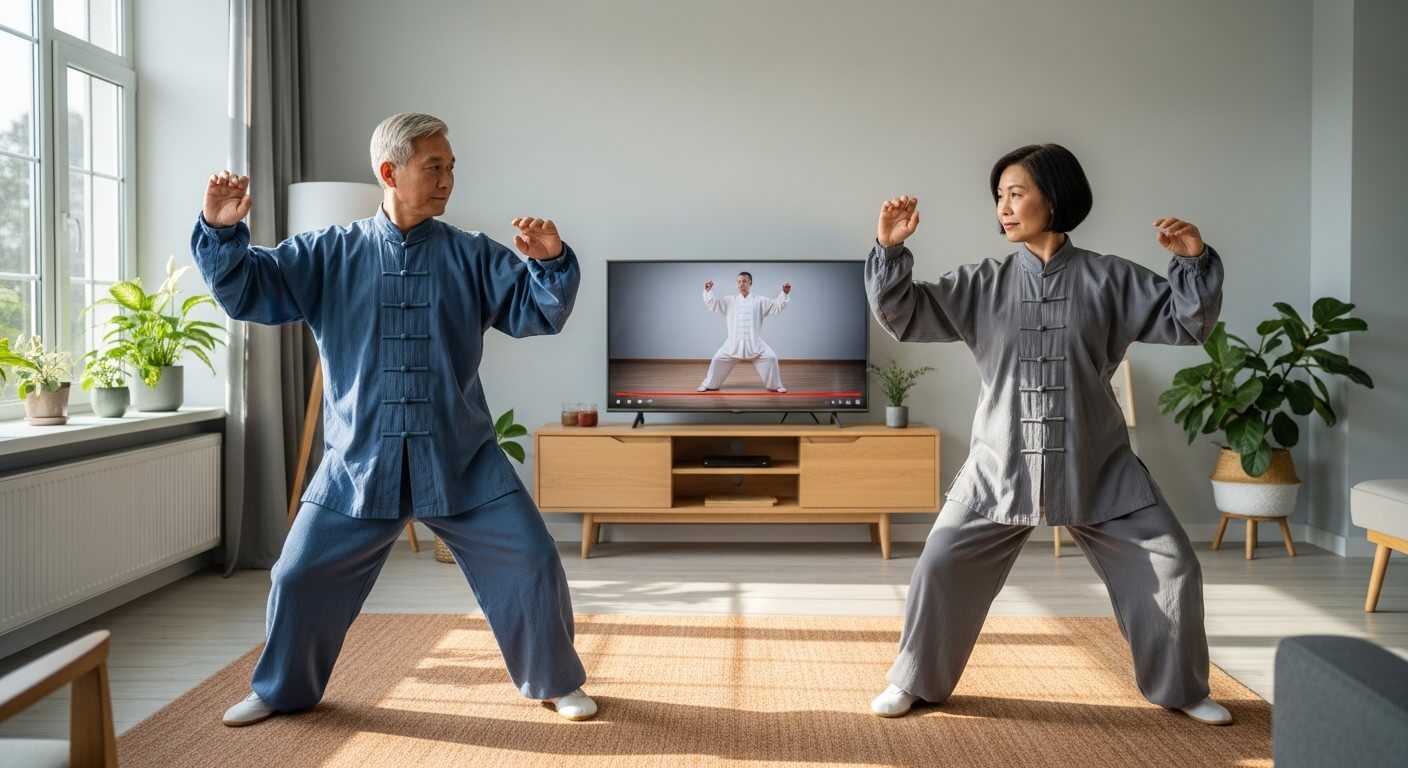
At Home
Dr Paul Lam, an Australian family physician and tai chi expert with more than 40 years of teaching experience, has a YouTube channel 'Dr Paul Lam – Tai Chi Productions' (https://www.youtube.com/@drpaullamtaichiproductions/) that consists of more than 100 videos that contain Tai Chi lessons that can help you deal with arthritis and fall prevention. The Centers of Disease Control and Prevention (www.CDC.gov) recommends his Tai Chi for Arthritis 12 lesson DVD program for fall prevention. Over five million people around the world practice his Tai Chi for Health programs every day.
The program is based on Sun style tai chi, chosen specifically for its healing properties, Qigong breathing components, higher stances that are easier on the knee and hip joints, and effectiveness in improving mobility and balance.
The program improves muscular strength to support and protect joints (reducing pain), flexibility to reduce stiffness and improve mobility, stamina for overall health, balance (both mental and physical), and also enhances relaxation, vitality, posture, and immunity.
You can also access all 15 of Dr Paul Lam's Tai Chi for Health programs online by visiting https://www.onlinetaichilessons.com/ and paying either a monthly fee of $40 or an annual fee of $299. If you join this program, you will also get access to his on-demand programs that cover the major forms and styles of Tai Chi including 24 forms, Sun Style 73 forms, Yang Style 40 forms, and Chen Style 36 forms.
In Person
The best ways to find qualified tai chi instruction for seniors include contacting local senior centers that offer specialized classes, researching certified instructors with geriatric training through national tai chi organizations, exploring community colleges with adaptive physical education programs, and connecting with healthcare providers who recommend therapeutic tai chi practitioners.
Also the YMCA offers free group Tai Chi classes to all YMCA members. The monthly membership fee is about $100. You will also have to pay a join fee that costs about $150. You might be able to get a monthly discount through your health insurer or if your household income is below a certain threshold.
| Program Type | Typical Cost | Class Duration |
|---|---|---|
| Senior Centers | $20-40/month | 45-60 minutes |
| Healthcare Programs | $50-100/month | 60-90 minutes |
| YMCA | FREE for all members | 60 minutes |
| Community Colleges | $60-120/semester | 75-90 minutes |
| Private Studios | $80-150/month | 60 minutes |
Is Tai Chi Covered by Insurance or Medicare programs?
Original Medicare Parts A and B will not cover the costs of gym memberships or fitness programs because they are not considered medically necessary services, unless they are required for physical therapy or some other medical treatment. However, some private insurance companies offer Medicare Advantage Part C plans and Medicare Supplement (Medigap) plans that will cover the costs of memberships to fitness programs like SilverSneakers, Silver&Fit, and Renew Active that have access to fitness programs such as Yoga and Tai Chi through participating gym locations or on-demand online videos.