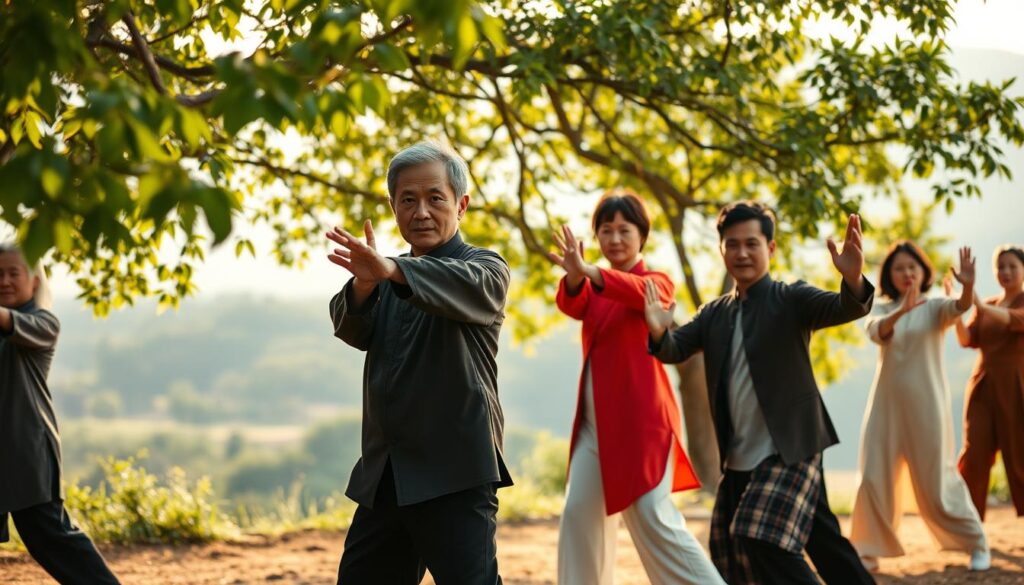
Tai chi walking for beginners means walking in slow motion with soft knees, an upright posture, and a full weight shift onto one leg before you step with the other. This is the footwork of tai chi, and you can learn the basic pattern in about ten minutes with a hallway or path. Harvard Health describes it as the footwork component of tai chi forms, a way to get the lower-body benefits without learning an entire form.[1] Below I walk you through the steps, the posture, the breathing, the common mistakes, and a practice plan. Where research exists, I cite it and note how strong it is.
Tai Chi Walking for Beginners in 7 Quick Steps
You can do tai chi walking by standing tall, shifting your weight onto one leg, stepping out without weight, and then slowly moving your weight into the new foot. I put the short version first so you can start immediately. The table below lists the seven steps in order, with the one thing to feel at each stage. Treat it as a checklist, and read the detailed tutorial further down for the reasoning behind each step.
| Step | What I Do | What I Should Feel |
|---|---|---|
| 1. Stand | Feet hip-width apart, knees soft, shoulders relaxed | Balanced and rooted |
| 2. Shift | Move nearly all my weight onto the back leg | The front foot feels light |
| 3. Step | Lift the front foot and place it forward with no weight on it | Control, with no wobble |
| 4. Roll | Slowly move my weight forward into the front foot | A smooth, gradual transfer |
| 5. Release | Let the back foot become light and ready | The back leg unloading |
| 6. Repeat | Step with the other foot | A steady left-right rhythm |
| 7. Breathe | Breathe slowly through the nose and relax | Calm, loose shoulders |
Harvard Health describes this pattern as an "empty step": you place the foot forward without weight, then pour your weight into it.[1]
What Is Tai Chi Walking? A Beginner-Friendly Definition
Tai chi walking is a slow, deliberate way of walking, borrowed from tai chi, that trains balance, leg control, and mindful attention. Tai chi itself is a centuries-old martial art and exercise built on slow, flowing movements, and a full routine is called a form.[1] Some forms can take up to a year to learn, which is why many beginners start with the walking alone.[1] The National Center for Complementary and Integrative Health (NCCIH) describes tai chi as slow, gentle movements and postures combined with a meditative state of mind and controlled breathing.[2] The two lists below cover how it differs from ordinary walking and where it comes from.
How Tai Chi Walking Differs From Regular Walking
Ordinary walking relies on momentum, while tai chi walking removes it. With momentum gone, you spend longer on each foot, which challenges your balance and trains you to stay upright as your center of gravity shifts.[1]
- Speed: slow and deliberate instead of automatic.
- Weight transfer: complete, one leg at a time, instead of continuous.
- Attention: mindful, with awareness of your feet and breath.
- Muscle use: smaller muscles in the feet, ankles, and lower legs do more of the work, and these muscles matter for balance and gait.[1]
Where Tai Chi Walking Comes From
Tai chi walking comes from taijiquan (tai chi), and it is taught as a foundation skill because it carries into every form.
- Origin: tai chi originated as an ancient Chinese martial art and has become more focused on health promotion and rehabilitation.[2]
- Related practice: when tai chi is done for health, it is considered a form of qigong.[10]
- Other names: you may see it called "mindful stepping," "tai chi stepping," or "cat walk."
Why Learn Tai Chi Walking as a Beginner? Key Benefits
Beginners learn tai chi walking mainly for better balance, stronger lower legs, and a calmer mind, though the research is strongest for balance and falls. I want you to have realistic expectations. Harvard's reviewer says claims online about large weight loss or bulging muscles from tai chi walking are false.[1] The table below separates what the evidence supports from what it only suggests.
| Benefit | What the Evidence Says | Strength of Evidence |
|---|---|---|
| Balance and fall prevention | A 2023 meta-analysis of 24 randomized trials found that tai chi reduced fall risk in older adults (relative risk 0.76)[5] | Moderate to good (tai chi in general, not walking alone) |
| Leg and ankle control | Slow, controlled steps engage smaller foot, ankle, and lower-leg muscles[1] | Expert description |
| Muscle strength | Harvard Health says regular tai chi can be comparable to resistance training and brisk walking[8] | Moderate |
| Joint comfort (knee and hip) | 2019 American College of Rheumatology and Arthritis Foundation guidelines strongly recommend tai chi for knee and hip osteoarthritis[2] | Guideline-supported |
| Stress and mood | NCCIH notes positive effects on anxiety, stress, and depressive symptoms that were not statistically significant[10] | Limited |
| Bone density | Slow, prolonged loading of each leg has the potential to enhance bone density[1] | Potential only |
Better Balance and Fall Prevention
This is the best-supported benefit, and it matters. The CDC reports that over 14 million older adults, about 1 in 4, fall each year, and about 37% of those who fall report an injury needing treatment or restricting activity.[4]
- Falls data: older adult falls lead to about 3 million emergency department visits and about 1 million hospitalizations each year.[3]
- Short-term results: a 2017 meta-analysis estimated that tai chi may reduce the rate of falls by about 43% over the short term (under 12 months).[6]
- Caveat: a 2019 review cited by NCCIH put the reduction in people who fall at 20% (high-certainty evidence) and the reduction in fall rate at 19% (low certainty).[2] The estimates vary, so I treat tai chi as helpful rather than a guarantee.
Stronger Legs, Ankles, and Core
You work the stabilizing muscles around the ankle and hip because you hold each single-leg stance longer than in normal walking.
- Smaller muscles: the feet, ankles, and lower legs do more of the work.[1]
- Posture: an upright spine and level hips recruit your core.
- Dose matters: the 2023 meta-analysis found that effectiveness increases with exercise time and frequency.[5]
Reduced Stress and a Calmer Mind
Tai chi walking is also a mindfulness practice. You resist the urge to speed up and focus on one step at a time, and you become more aware of your breathing.[1]
- Realistic view: Harvard lists lower stress, better mood, and better sleep among tai chi's possible benefits, and says it "may" help.[1]
- Research gap: the stress findings from NCCIH were positive but not statistically significant.[10]
Gentle Movement for Joints
Tai chi walking is low-impact, so I find it a comfortable starting point for stiff joints, though you should clear it with your clinician first.
- Knee and hip osteoarthritis: supported by the 2019 guideline noted above.[2]
- Pain research: a 2021 review of 16 studies found low-to-moderate evidence that tai chi helped knee osteoarthritis pain, stiffness, function, and balance.[2]
An Easy Entry Point to Beginner Tai Chi
Because tai chi walking skips memorizing a full form, it gives you the lower-body benefits with far less to learn.[1] Later you can add arm movements and short forms.
Before You Start: What You Need for Tai Chi Walking for Beginners
You need very little: flat shoes or bare feet, loose clothes, and about 10 to 15 feet of clear, level floor. Harvard says all you need is a sidewalk, pathway, or hallway.[1] I also recommend a wall or sturdy chair within reach while you learn. The sections below cover clothing, space, timing, and safety checks.
Best Clothing and Shoes for Beginner Tai Chi Walking
Thin, flat soles let you feel the ground, which helps with the weight transfer.
- Footwear: flat, flexible shoes, tai chi shoes, or bare feet on a safe surface.
- Clothing: loose, stretchy clothing that doesn't restrict your knees or hips.
- Avoid: heels, thick cushioned soles, and slippery socks.
How Much Space You Need to Practice Tai Chi Walking
A hallway or room length of 10 to 15 feet works, since you can turn and walk back.
- Indoors: a flat, non-slip floor, with rugs and clutter cleared.
- Outdoors: a quiet path or lawn once you feel steady.
The Best Time and Setting for Beginners
Pick a calm time. A rushed practice defeats the purpose.
- Timing: morning or evening, when you are not hurried.
- Setting: quiet, with no one needing you.
- Meals: tai chi instructors often advise against practicing right after a meal or when very tired.[16]
Safety Checks Before You Begin
Tai chi is generally safe, but take these precautions first.
- Support nearby: keep a wall, rail, or sturdy chair within arm's reach.
- Medical check: the Healing Works guide advises talking to a health care provider first if you are pregnant or have chronic back problems or a hernia.[14]
- Do not delay care: NCCIH advises against using tai chi to postpone seeing a provider about a medical problem.[2]
Tai Chi Walking Posture for Beginners: Setting Your Foundation
Good tai chi walking posture means standing tall and relaxed, with soft knees, level hips, loose shoulders, and eyes looking ahead. I always set posture before stepping because every step builds on it. The table below shows each body area with a cue I use. These cues are my own teaching points, and individual instructors vary in the details.
| Body Area | What I Do | Common Cue |
|---|---|---|
| Feet | Hip-width apart, pointing forward | "Two parallel train tracks" |
| Knees | Slightly bent, never locked | "Soft, not collapsed" |
| Pelvis and spine | Tailbone slightly tucked, spine long | "A string lifting the crown" |
| Shoulders | Dropped and relaxed | "Heavy shoulders" |
| Arms and hands | Hanging loosely, fingers soft | "Holding a small ball of air" |
| Head and eyes | Chin level, gaze ahead | "Look at the horizon" |
Foot Position and Stance Width
Hip-width feet give you a stable base. Narrow stances wobble, and wide stances stiffen your hips.
Knee Alignment and Soft Knees
Keep your knees pointing in the same direction as your toes. Soft knees absorb weight shifts and protect the joint.
Pelvis and Spine: Standing Tall Without Stiffness
Imagine your head floating upward while your tailbone drops. Avoid arching your back or leaning forward.
Shoulders, Arms, and Hands
Let your shoulders drop away from your ears. Tension here travels down and disturbs your balance.
Head Position and Eye Gaze
Look ahead at a fixed point. Looking down at your feet tips your balance forward.
Step-by-Step Tai Chi Walking Tutorial for Beginners
To learn tai chi walking step by step, move through seven stages: stand, shift your weight back, lift and place the front foot with no weight, roll your weight forward, release the back foot, repeat on the other side, and add breathing. Go slowly, because speed hides errors. Harvard notes you can perform the movements forward, sideways, or backward, and that watching a video or learning from an instructor may help.[1] The steps below follow Harvard's "empty step" principle, and I describe the foot landing the way I teach it. Some teachers land on the heel while others place the foot nearly flat, and both keep the step empty.
Step 1: Start in the Beginner Tai Chi Walking Stance
How to Stand
- Feet: hip-width apart and parallel.
- Knees: slightly bent.
- Posture: tall spine, relaxed shoulders, gaze forward.
What Your Body Should Feel Like
- Weight: evenly spread across both feet.
- Body: loose and steady, with no tension in the neck or jaw.
Step 2: Shift Your Weight to Your Back Leg
How to Transfer Your Weight Slowly
- Move: slowly, shifting almost all your weight onto one leg.
- Hips: keep them level, without swaying.
Test: Can You Lift the Front Foot Without Wobbling?
- Check: if you can lift the other foot easily, your weight is fully shifted.
- If you wobble: touch the wall or chair, and shift a little more.
Step 3: Lift and Step Forward the Tai Chi Way
How High to Lift Your Foot
- Height: just enough to clear the floor, a few inches.
Where to Place Your Foot (Distance and Width)
- Distance: about a half to one foot-length ahead, which is shorter than your usual stride.
- Width: keep your feet hip-width apart, not on a tightrope line.
Why You Land Lightly First
- Empty step: Harvard describes placing the front foot on the ground without putting any weight on it.[1]
- Heel or flat: I land on the heel first, nearly flat, so the toes stay relaxed.
Step 4: Roll Your Weight Forward
The Heel-to-Toe Roll Explained
- Feel: you slowly "pour" your weight into the front foot.[1]
- Pace: take at least several seconds per transfer.
Keeping the Hips Level and Smooth
- Hips: move forward evenly, without bobbing up and down.
- Back foot: it stays soft as the weight leaves it.
Step 5: Bring Your Back Foot Forward
Releasing the Back Foot Gently
- Release: once the front leg holds all your weight, the back foot becomes light.
Keeping Your Upper Body Still
- Torso: stays upright and quiet while the legs do the work.
Step 6: Repeat on the Other Side
Building a Smooth Left-Right Rhythm
- Rhythm: each step flows into the next without pauses or lurches.
Practicing Tai Chi Walking Steps for Beginners Slowly
- Pace: if you are speeding up, shorten your path and slow down.
Step 7: Add Breathing and Relaxation
Simple Breathing Pattern for Beginners
- Pattern: breathe naturally at first, then match the breath to the movement (see the breathing section below).
Releasing Tension as You Walk
- Check in: every few steps, scan the shoulders, jaw, and hands.
Recap table
| Step | Action | Feeling |
|---|---|---|
| 1 | Stand tall, knees soft | Rooted |
| 2 | Shift weight back | Front foot light |
| 3 | Place the foot, no weight | Controlled |
| 4 | Roll weight forward | Smooth |
| 5 | Release back foot | Light |
| 6 | Repeat other side | Rhythmic |
| 7 | Breathe and relax | Calm |
Tai Chi Walking Forward, Backward, and Sideways for Beginners
You can practice tai chi walking in three directions, and I recommend mastering forward before trying the others. Harvard confirms the same basic pattern works forward, sideways, or backward.[1] Backward and sideways steps need more caution because you can't see where you're going. The list below summarizes each direction.
Tai Chi Walking Forward (The Basic Beginner Pattern)
- Use: the seven steps above.
- Simpler option: keep your feet parallel and skip the forward-and-back rocking of the weight.[1]
Tai Chi Walking Backward for Beginners
- Landing: place the toes down first, with no weight.
- Weight: shift slowly back into the heel side of the foot.
- Safety: keep a clear path and a wall nearby, and glance behind you first.
Sideways Tai Chi Stepping for Beginners
- Step: shift your weight, slide one foot out, then shift into it and bring the other foot in.
- Keep: your hips level and your toes forward.
Turning While Tai Chi Walking (Beginner Pivot Technique)
- Pivot: put your weight on one leg, turn the other foot's toes slightly, then shift into the new direction.
- Avoid: twisting the knee. Turn from the hips and the foot.
Tai Chi Walking Arm Movements for Beginners
For beginners, the best arm movement is none: keep your arms relaxed at your sides until the footwork feels automatic. Arms add coordination demands, so I introduce them only after the legs are steady. The list below shows a gradual progression you can follow.
Keeping Your Arms Relaxed at Your Sides
- Position: arms hang loose with soft elbows.
- Goal: no tension in the shoulders.
Simple Arm Swing Coordination for Beginner Tai Chi Walking
- Gentle swing: let the opposite arm swing slightly forward as you step, the way you naturally walk.
- Keep: the swing small and slow.
Adding Hand Positions Once You Feel Steady
- Hands: hold them in front of your belly as if cradling a ball.
- Progress: later, borrow simple arm movements from short tai chi forms.
Breathing Techniques for Tai Chi Walking for Beginners
The simplest breathing for tai chi walking is slow, natural, nasal breathing that you gradually sync with your steps. Tai chi walking makes you more aware of your breathing.[1] Don't force a pattern at first, because breath-holding is a common beginner error. The sections below show how to progress.
Natural Breathing vs. Coordinated Breathing
- Natural: breathe normally while you learn the footwork.
- Coordinated: once steady, link your breath to each step.
Matching Breath to Steps (Simple Inhale/Exhale Pattern)
- Inhale: as you shift your weight back and lift the foot.
- Exhale: as you place the foot and shift forward.
Using Your Breath to Stay Calm and Focused
- Anchor: if your mind wanders, return to the breath.
- Posture check: a long exhale helps drop your shoulders.
Common Mistakes in Tai Chi Walking for Beginners (and How to Fix Them)
The most common beginner mistakes are stepping too fast, bobbing up and down, locking the knees, and holding the breath. I see these patterns in most beginners, and each has a quick fix. The table below pairs each mistake with its cause and a correction.
| Mistake | Why It Happens | Fix |
|---|---|---|
| Stepping too fast | Habit and impatience | Count slowly through each transfer |
| Bobbing up and down | Straight legs, uneven weight shift | Keep knees soft, hips level |
| Locked knees | Fear of wobbling | Keep a gentle bend |
| Flat-footed or toe landing | Old walking habits | Practice the light heel or flat landing |
| Holding your breath | Concentration | Hum or breathe through the nose |
| Looking down | Wanting to check foot placement | Fix your gaze on a point ahead |
| Steps too wide or long | Trying to cover distance | Shorten the step to about a foot length |
Stepping Too Fast
- Fix: slow until each transfer takes several seconds.
Leaning or Bobbing Up and Down
- Fix: imagine a pane of glass at head height.
Stiff Knees or Locked Legs
- Fix: keep a "soft" bend throughout.
Landing Flat-Footed or on the Toes
- Fix: land lightly and roll the weight forward.
Holding Your Breath
- Fix: exhale on each step.
Looking Down at Your Feet
- Fix: look ahead.
Taking Steps That Are Too Wide or Too Long
- Fix: use a half to one foot-length stride.
Beginner Tai Chi Walking Practice Routine
A good beginner routine is 10 minutes a day: warm up, walk forward, add backward and sideways steps, then cool down. I built this routine myself from the structure above, so treat it as a starting point and not as a clinically tested protocol. The 2023 meta-analysis found that effectiveness increases with exercise time and frequency,[5] which is why I favor short, frequent sessions. Many NCCIH-cited studies used 60-minute sessions, typically one to three times weekly,[2] so you may eventually want a longer class too.
A 10-Minute Tai Chi Walking Routine for Beginners
| Phase | Time | What I Do |
|---|---|---|
| Warm-up | 2 min | Ankle circles, gentle knee bends, shoulder rolls |
| Forward practice | 4 min | Slow tai chi walking, 10 to 15 feet |
| Backward and sideways | 2 min | A few steps each way, near a wall |
| Cool-down | 2 min | Stand still, breathe, notice how you feel |
Warm-Up (2 Minutes)
- Focus: loosen the ankles, knees, and hips.
Forward Tai Chi Walking Practice (4 Minutes)
- Focus: weight transfer and level hips.
Backward and Sideways Practice (2 Minutes)
- Focus: slow control with support nearby.
Cool-Down and Reflection (2 Minutes)
- Focus: quiet standing, deep breaths, a short body scan.
4-Week Tai Chi Walking for Beginners Progression Plan
| Week | Focus | Goal |
|---|---|---|
| 1 | Learning the weight shift | Stand on one leg comfortably |
| 2 | Smooth, slow stepping | Steady rhythm |
| 3 | Breath and arm movement | Coordinated breathing |
| 4 | Longer paths and turning | Walk and pivot smoothly |
Week 1: Learning the Weight Shift
- Task: practice shifting only, without stepping.
Week 2: Smooth, Slow Stepping
- Task: link steps into a continuous line.
Week 3: Adding Breath and Arm Movement
- Task: coordinate the exhale with each step.
Week 4: Walking Longer Paths and Turning
- Task: extend your path and add gentle turns.
How Often Should Beginners Practice Tai Chi Walking?
- My suggestion: 10 minutes, 4 to 7 days a week.
- Evidence note: the research supports frequency but does not set an exact number for tai chi walking.[5]
Tai Chi Walking Variations for Beginners With Special Needs
Tai chi walking can be adapted for older adults, people with balance issues, and those who need support, using a wall, rail, or chair. The Healing Works guide notes that tai chi can be modified for people with pain, weakness, or recent surgery, and most practices can be done seated.[14] NIH notes that tai chi movements may be done while walking, standing, or sitting.[13] The list below covers the main variations, but please get medical clearance when you have a condition affecting your balance.
Tai Chi Walking for Beginners Over 60
- Evidence: the 2023 meta-analysis found tai chi effective for fall prevention in older adults, whether healthy or at high risk.[5]
- Approach: shorter steps, a wall or rail nearby, and slower progress.
Chair-Supported Tai Chi Walking for Beginners
- Setup: place a sturdy chair back at your side and rest a hand on it.
- Option: practice the weight shifts seated first.
Tai Chi Walking for Beginners With Balance Issues
- Approach: stay at the shift-only stage until you are steady.
- Support: keep a wall or counter within reach at all times.
- Evidence: NCCIH says tai chi may help balance and fall prevention in older adults and in people with Parkinson's disease.[2]
Tai Chi Walking Using a Wall or Rail for Support
- Method: walk along a wall with a fingertip touch, and reduce support over time.
Tai Chi Walking Outdoors for Beginners (Grass, Paths, Uneven Ground)
- Start: on smooth paths, since uneven ground raises the challenge.
- Progress: try grass only once you feel steady.
Tai Chi Walking vs. Regular Walking for Beginners
Tai chi walking and regular walking are different tools: tai chi walking trains balance and mindfulness, while brisk walking is better for general aerobic fitness. I use both. Harvard's reviewer cautions that tai chi walking is not a path to large weight loss.[1] Harvard's general advice for ordinary walking is to start with 10 to 15 minutes at a time and build toward 30 to 60 minutes on most days.[12] The table compares the two.
| Feature | Tai Chi Walking | Regular Walking |
|---|---|---|
| Pace | Very slow | Moderate to brisk |
| Main focus | Balance, control, awareness | Aerobic fitness, distance |
| Balance training | High | Low to moderate |
| Calorie burn | Low | Higher |
| Mental benefits | Mindfulness, breath awareness | Mood and memory benefits |
Comparing Benefits
- Tai chi walking: balance and body awareness.[1]
- Regular walking: studies suggest walking and other physical activity may improve memory and resist age-related memory loss.[12]
When to Choose Each Style
- Choose tai chi walking: for balance work or a calm, focused session.
- Choose brisk walking: for cardio and longer distances.
Combining Both for a Balanced Routine
- Idea: do 5 to 10 minutes of tai chi walking as a warm-up before a regular walk.
Tips to Improve Your Tai Chi Walking as a Beginner
The best way to improve is to practice slowly and often, focus on one body part at a time, and learn from a qualified teacher or good video. The list below gives the tips I find most useful.
Practice Slowly Before Trying to Perfect Form
- Rule: slow first, polished later.
Use a Mirror or Record Yourself
- Check: see whether your head bobs or your knees lock.
Focus on One Body Part at a Time
- Cycle: feet, then knees, then hips, then shoulders.
Practice Mindful Awareness Throughout the Day
- Habit: notice your weight shifts as you walk to the kitchen.
Learn From a Class or Video
- Classes: Harvard suggests classes at senior centers, health clubs, YMCAs, community centers, or hospitals.[9]
- Instructor: NCCIH notes there is no national standard for tai chi certification, so ask about an instructor's training and experience.[2]
Safety Tips for Tai Chi Walking for Beginners
Tai chi walking is considered safe for most beginners, but stop if you feel pain, dizziness, or instability. A 2019 meta-analysis of 24 studies (1,794 participants) found that the frequency of adverse events was similar for people doing tai chi, another active intervention, or no intervention.[11] The adverse events related to tai chi were minor, such as musculoskeletal aches and pain.[2] The list below covers what I watch for.
Warning Signs to Stop Practicing
- Stop if you feel: sharp pain, dizziness, chest discomfort, or sudden weakness.
- Next step: contact a clinician if symptoms persist.
Protecting Your Knees and Hips
- Knees: keep them aligned with your toes and never locked.
- Joint conditions: talk to your provider first, and ask a qualified instructor for modifications.[14]
Practicing Safely at Home
- Space: clear floors, good lighting, and a support nearby.
- Footwear: flat and non-slip.
Moving Beyond Tai Chi Walking for Beginners: What to Learn Next
After tai chi walking, the natural next steps are short tai chi forms, simple qigong exercises, and a beginner class. NCCIH notes that tai chi is one of hundreds of qigong forms,[10] so the two practices fit together. Harvard Health's tai chi basics video, for example, teaches six basic movements with gentle motion and comfortable breathing.[17]
Basic Tai Chi Forms to Try After Walking Practice
- Starter forms: short sequences of 6 to 8 movements.
- Why: your footwork carries straight into them.
Qigong Exercises That Complement Tai Chi Walking
- Evidence: a 2019 survey of reviews found sufficient evidence to support qigong for balance training and fall prevention.[10]
Finding Beginner Tai Chi Classes and Online Resources
- Where: community centers, YMCAs, senior centers, and hospital wellness programs.[9]
- Cost: Harvard has reported class prices ranging from about $7 to $18 for an hourlong class, though prices vary.[15]
Tracking Your Progress as You Learn Tai Chi Walking
- Simple log: note minutes practiced, how steady you felt, and any soreness.
- Milestone: holding a single-leg stance comfortably before each step.
Sources
- Harvard Health Publishing, "Tai chi walking: What is it and does it work?" https://www.health.harvard.edu/exercise-and-fitness/tai-chi-walking-what-is-it-and-does-it-work
- National Center for Complementary and Integrative Health (NCCIH), "Tai Chi: What You Need To Know." https://www.nccih.nih.gov/health/tai-chi-what-you-need-to-know
- Centers for Disease Control and Prevention, "Older Adult Falls: At a glance." https://www.cdc.gov/Falls/facts.html
- Centers for Disease Control and Prevention, "Older Adult Falls Data." https://www.cdc.gov/falls/data-research/index.html
- Chen W, et al. "Tai Chi for fall prevention and balance improvement in older adults: a systematic review and meta-analysis of randomized controlled trials." Frontiers in Public Health, 2023. https://doi.org/10.3389/fpubh.2023.1236050
- Lomas-Vega R, et al. "Tai Chi for Risk of Falls: A Meta-analysis." Journal of the American Geriatrics Society, 2017. https://www.pubmed.gov/28736853/
- NCCIH, "Building the Understanding of the Effects of Tai Chi Training on Walking in Older People." https://www.nccih.nih.gov/research/research-results/building-the-understanding-of-the-effects-of-tai-chi-training-on-walking-in-older-people
- Harvard Health Publishing, "The health benefits of tai chi." https://www.health.harvard.edu/staying-healthy/the-health-benefits-of-tai-chi
- Harvard Health Publishing, "Best exercise for balance: Tai chi." https://www.health.harvard.edu/staying-healthy/best-exercise-for-balance-tai-chi
- NCCIH, "Qigong: What You Need To Know." https://www.nccih.nih.gov/health/qigong-what-you-need-to-know
- NCCIH, "Psychological and Physical Practices for Older Adults: What the Science Says." https://www.nccih.nih.gov/health/providers/digest/psychological-and-physical-practices-for-older-adults-science
- Harvard Health Publishing, "5 of the best exercises you can ever do." https://www.health.harvard.edu/staying-healthy/5-of-the-best-exercises-you-can-ever-do
- NIH News in Health, "Tai Chi and Your Health." https://newsinhealth.nih.gov/node/86
- Healing Works Foundation, "Moving Meditations Pocket Guide 2025." https://healingworksfoundation.org/wp-content/uploads/2019/06/Moving-Meditations-Pocket-Guide2025.pdf
- Harvard Health Publishing, "Looking for a mellow form of exercise? Try tai chi." https://www.health.harvard.edu/heart-health/looking-for-a-mellow-form-of-exercise-try-tai-chi
- NCCAM (now NCCIH), "Tai Chi: An Introduction" (archived 2012 version). https://webarchive.library.unt.edu/web/20120928000255/http://nccam.nih.gov/health/taichi/introduction.htm
- Harvard Health, "Video: Tai chi basics." https://www.harvardhealth.org/iap-w3-resource-02
This article is educational and does not replace advice from your doctor or physical therapist. The step-by-step technique reflects Harvard's published description and common teaching practice, and instructors vary in the details.